Apple Arcade vs Google Play Pass Game Library Comparison
Apple's curated boutique beats Google's discount warehouse if you value quality over quantity.
Mobile gaming stopped being a side hobby a while back and turned into the main event. Newzoo's 2026 numbers put it at 3.10 billion players worldwide, which works out to 83.9% of everyone who plays games on any device. Apple Arcade and Google Play Pass both exist to fix the same annoyance in that market, but they fix it in almost opposite ways, and figuring out which one matches how you actually play is the whole point of this piece.
Revenue backs up how central mobile has become. Newzoo's 2026 forecast has mobile at $121.1 billion, or 56.6% of the entire global games market, ahead of both console and PC, with console holding the larger share of that remainder. That much money flowing through app stores also explains why those stores are so cluttered with ads, countdown timers, and in-app purchase prompts that pop up right as you're trying to enjoy something. The vast majority of mobile users quit a new game inside 30 days, and the friction of ads and in-app purchase prompts is a widely cited part of that pattern. Nobody wants to wonder if tapping "continue" is about to cost four dollars.
A flat monthly fee is the fix both Apple and Google landed on. Pay once, skip the ads, skip the microtransactions, stop doing mental math every time a game asks for money. That's where the agreement ends, though. What each company built on top of that shared idea diverges almost completely, and that divergence is what the rest of this article walks through.
The core philosophical divide: how Apple and Google built opposite answers to the same question
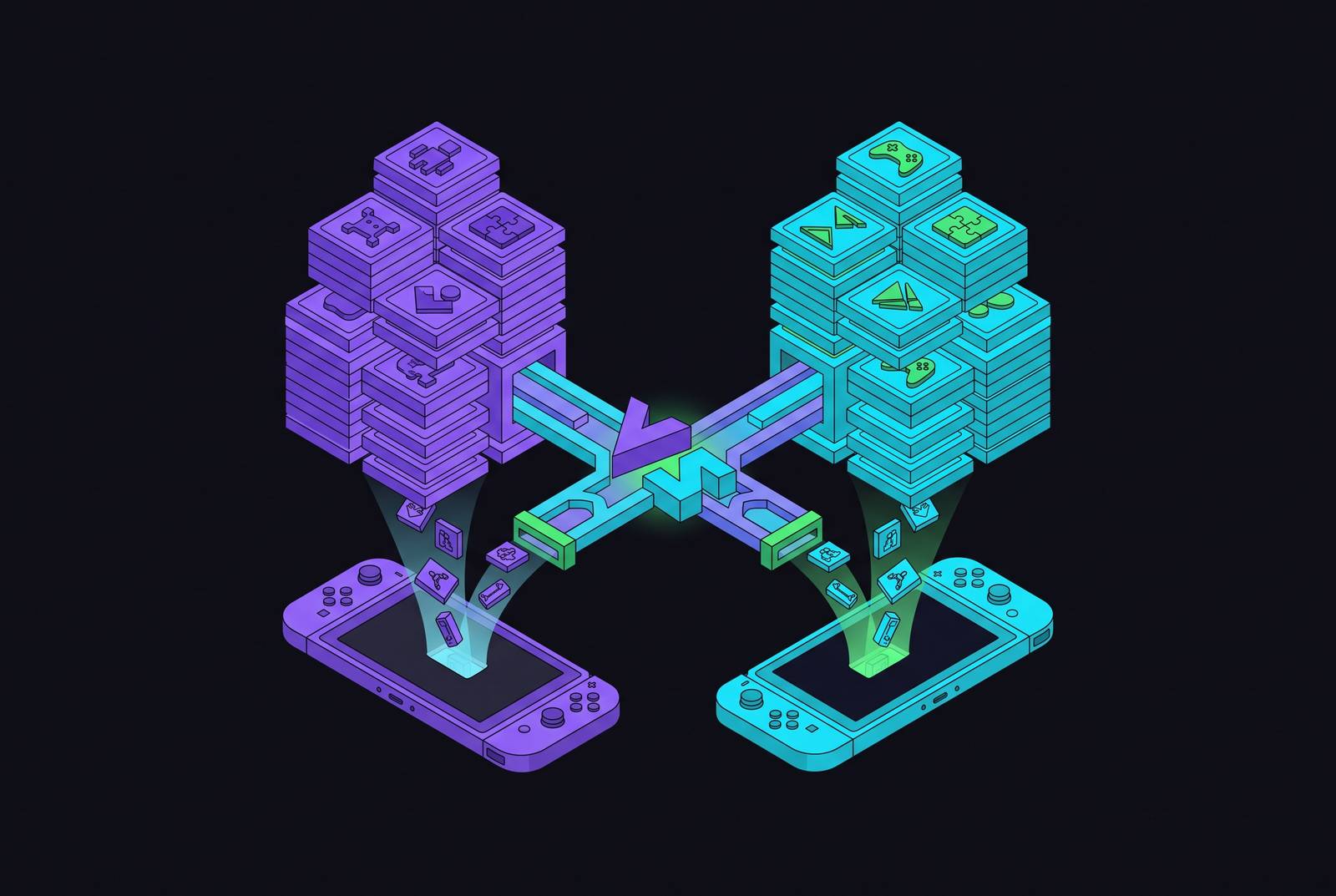
Apple Arcade behaves like a boutique. Every game gets vetted before it's allowed in, several titles are built specifically for the platform and exist nowhere else, and the whole library runs with zero ads and zero in-app purchases. Quality control is the entire premise. Think of it as a curated gallery show: fewer pieces on the wall, but somebody stood there and decided each one belonged.
Google Play Pass runs more like a discount warehouse. It unlocks over 1,000 games and apps that already live on the Play Store, stripping out the ads and purchase prompts from titles you could otherwise download for free (with all their friction intact) or buy at full price. Breadth is the organizing idea here, not curation.
This split appears clearest in exclusivity. Apple Arcade has Arcade Originals, games that were made for the service and can't be found anywhere else. Play Pass has none. Every title in it already exists on the open Play Store, just with the rough edges sanded off. Neither approach beats the other on paper. It genuinely depends on whether someone wants to browse a big pile and hope for gems, or wants a shorter list where the vetting's already done.
Library size and the filler problem: what 200+ games vs. 1,000+ means
Apple Arcade is over 200 titles, with new games added on a rolling basis. Google Play Pass launched with a few hundred apps and games, grew past 800, and multiple 2026 sources now put it above 1,000, with new titles added on a rolling monthly basis.
That number sounds like a landslide victory for Play Pass until you start actually scrolling through it. Android Central counted nine separate Solitaire variants in the library. Nine. Android Police described the experience of browsing Play Pass as walking through a thrift store, where something like 90% of what's on the shelf just gets ignored. One listed title, JapaneseOfficeSimulator, was reportedly still showing unskippable ads despite being part of a service whose entire pitch is no ads. That's not a small crack in the pitch; that's the foundation.
Part of the inflated number comes down to what's even being counted. Play Pass bundles in productivity apps and utility tools alongside actual games, which pads the headline figure without adding a single new thing to play. Apple Arcade's 200-plus is games only, full stop, which makes it a cleaner number even though it's smaller. What matters is what 200 versus 1,000 actually means. It's 200 curated games versus a fraction of that number actually worth your time buried inside 1,000.
The games that define each service: notable titles, Originals, and cross-service overlap
Apple Arcade's roster includes Balatro, Vampire Survivors, Dead Cells, Cult of the Lamb Arcade Edition, Powerwash Simulator, and Stardew Valley (available as Stardew Valley+ on the service). The Originals column has Sneaky Sasquatch, Sonic Dream Team, and Hello Kitty Island Adventure, none of which show up anywhere else.
Apple's clearest signal of commitment in 2026 wasn't a marketing slide, it was a checkbook: Apple acquired the studio behind Sneaky Sasquatch. That's a company betting real money on one of its own exclusives rather than just licensing it for a season. The Apple Games app has also started surfacing Arcade content more prominently, which suggests the service is getting pushed rather than left to fend for itself in a crowded menu.
Recent additions include Good Pizza, Great Pizza+, Perchang World, and Ultimate 8 Ball Pool+, alongside crossover events, Bluey now appears across five different titles, and Barbie, Hello Kitty, and Star Wars worlds have all gotten exclusive updates. Genre-wise, though, Arcade has a real gap: FPS games and deep RPGs are thin on the ground. If twitch shooters or 80-hour role-playing epics are the draw, that's worth knowing before subscribing.
Pricing, annual math, and the family sharing calculation
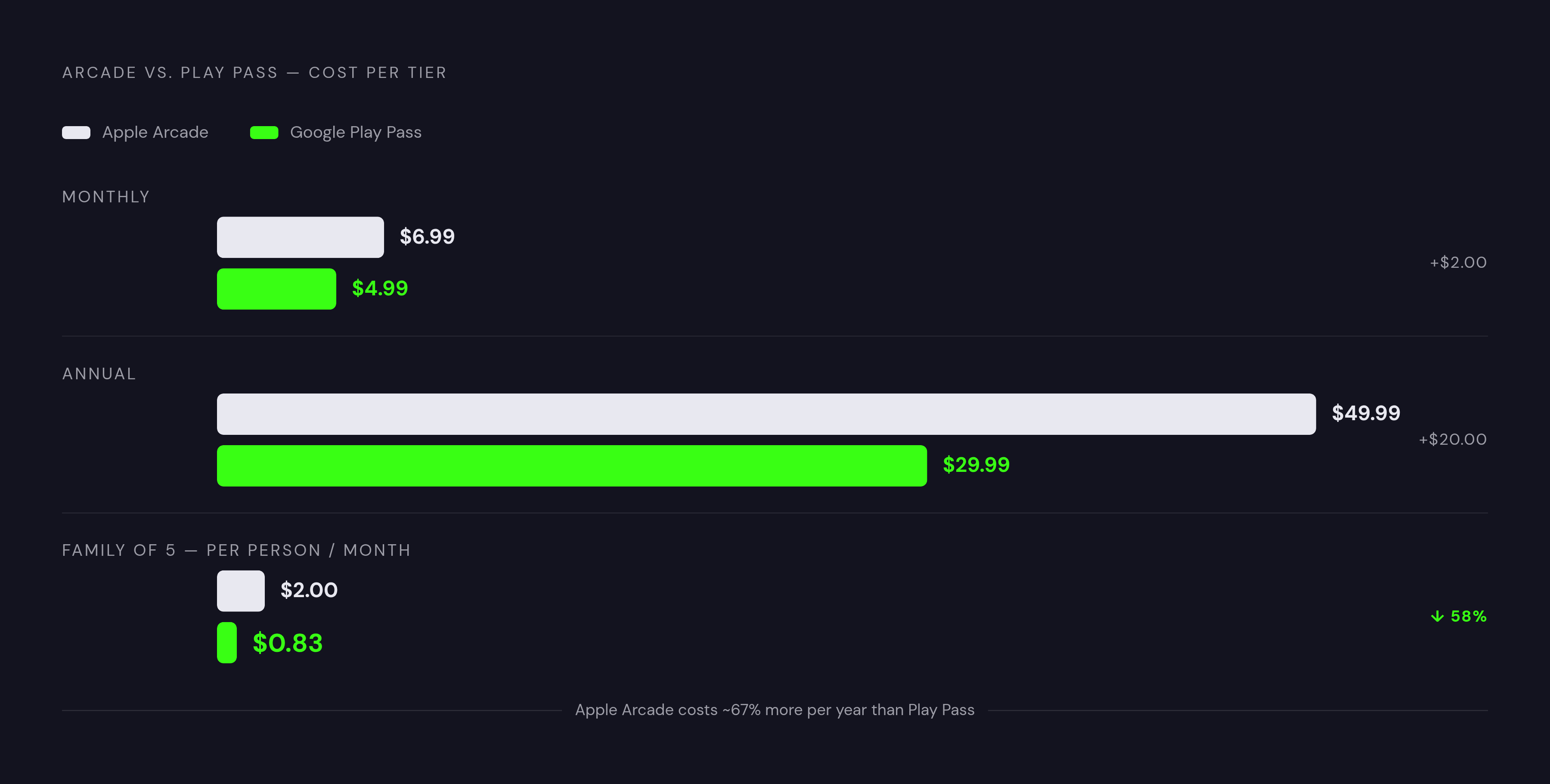
Monthly, Apple Arcade runs $6.99 and Google Play Pass runs $4.99. Two dollars doesn't sound like much until you let it compound across twelve months.
Annually, Apple Arcade costs $49.99, which works out to about $4.16 a month if paid up front. Google Play Pass costs $29.99 a year, roughly $2.50 a month. That's a $20 gap annually, meaning Apple Arcade costs about 67% more over a full year than Play Pass does. Apple Arcade offers a one-month free trial, while Google Play Pass offers a 10-day free trial, so both let you test the waters before committing.
Buying new Apple hardware changes the math directly: Apple Arcade includes three months free bundled with every new eligible iPhone, iPad, Mac, or Apple TV for new and qualifying returning subscribers, limited to one offer per person. There's no Play Pass equivalent tied to Android hardware purchases. For someone who was going to buy a new iPhone anyway, that free quarter erases a meaningful chunk of the price gap before it even starts.
Device reach and offline play: which hardware you own often decides this before anything else
Apple Arcade covers iPhone, iPad, Mac, Apple TV, and Apple Vision Pro, with games syncing across all of them through a single Apple ID. It's download-only, not a streaming service, so titles have to actually live on the device before you can play them. That means offline play works completely once installed, no connection needed mid-session, but it also means storage space matters in a way it wouldn't for something streamed.
Google Play Pass runs on any Android device on version 4.4 or higher, using Play Store app version 16.6.25 or above, in supported countries. Given how wide Android's footprint is across price points globally, that's a considerably larger potential hardware base than Apple's closed ecosystem. Play Pass titles also work offline once downloaded, similar to Arcade, but if the subscription lapses, those installed apps don't just vanish, they revert back to their ad-supported or paid versions. Play Pass titles remain accessible offline once downloaded, but if the subscription lapses, those installed apps don't just vanish, they revert back to their ad-supported or paid versions.
Controller support and playing these games the right way
Reported figures suggest that well under half of active Apple Arcade titles officially support a controller, which is a bigger gap than the marketing might suggest. The titles that do it well include Dead Cells+, Balatro+, and Oceanhorn 3, and they're worth seeking out specifically for that reason. Some Arcade titles, particularly ones limited to iPhone or iPad, have no controller support whatsoever, so it's worth checking before assuming a pad will work.
Google Play Pass fares better on this specific point. Dead Cells on Android has full controller support alongside custom touch controls, and Stardew Valley on Play Pass handles a controller smoothly, making it a strong example of a play experience that goes well beyond what touch controls alone can offer.
Why does any of this matter beyond comfort? Because a controller doesn't just make a game easier to hold, it unlocks the design the developers actually intended. Dead Cells was built around analog input, precise stick movement, and trigger pressure, the works. Playing them with touch controls is like reading a graphic novel with half the panels torn out: technically possible, but you're missing the thing that made it worth doing.
Which subscription fits which kind of player
Apple Arcade makes the most sense for someone already living inside Apple's ecosystem, iPhone, iPad, Mac, Apple TV, who wants a game to pick up on one device and continue on another without thinking about it. It also suits players who'd rather not sift through filler and want every title pre-vetted before it reaches their screen. The exclusives matter too: Sneaky Sasquatch, Sonic Dream Team, and Hello Kitty Island Adventure exist only here, alongside Bluey crossover content that spans multiple Arcade titles. Buying a new Apple device makes the case even stronger, since the three-month bundle wipes out most of the price premium for a quarter of the year. Households already paying for other Apple services should also check the Apple One bundle, since it can shift the per-service math meaningfully. Genre-wise, Arcade plays best for puzzle, narrative, adventure, and simulation fans; shooter and RPG diehards should weigh the documented gaps first.
Google Play Pass is the better fit for Android users chasing the widest possible selection at the lowest yearly cost, $29.99 against Arcade's $49.99. It rewards people who enjoy digging, who treat scrolling through a big, messy library as part of the fun rather than a chore to get through. Genre depth also leans its way in specific spots: titles like KOTOR and Terraria fill gaps that Arcade's catalog leaves open. Cancellation terms are gentler too, since data and installed games stick around (in reverted form) rather than disappearing. For a household of up to five people all gaming on Android, the annual per-person cost comes out to roughly $0.83 a month, the cheapest per-head number of the two services.
Honestly, for most people, this decision gets made the moment they choose a phone, long before either subscription enters the picture. The real dilemma only affects the smaller group straddling both ecosystems, or anyone weighing a new device purchase partly on what the attached subscription offer is worth.