PlayStation Plus vs Xbox Game Pass for Mobile Gamers
Xbox edges PlayStation for phone-only players, but its 2026 hour cap shifts the value.
PlayStation Plus and Xbox Game Pass offer different answers to the same mobile question. Can a phone be your main gaming screen? Xbox is the clearer fit for players without a console, but its November 2026 cloud-hour cap complicates that advantage. For PS5 owners, free PS Remote Play may be a better choice than another subscription.
Why the screen you play on changes what a subscription is worth
A commuter playing during a lunch break needs more than a large library. The game must reach the phone without first requiring a console download, and the route into it must be simple enough for a short session. A capable mobile interface is part of the service. A catalog full of appealing games offers little value if the subscriber cannot play them on the screen at hand.
That changes the basis of the comparison. Both services were built for consoles first, even though mobile brings in most of the world’s games revenue and has more players than console gaming. But they work very differently when play moves off the television. For a phone-first player, the architecture of each service determines value before price or catalog size enters the calculation.
How Xbox Game Pass and PlayStation Plus are structurally built, and why it matters for phones
Xbox Game Pass works as a cross-device library, connecting play across console, PC, phone, tablet and smart TV. Cloud gaming makes the phone a destination in its own right rather than merely a display attached to hardware at home. That distinction is the foundation of its mobile appeal. The subscription can provide both access to games and a way to run them without owning a console, although the exact benefits depend on the plan.
PlayStation Plus is built around the PS5. Its downloadable catalogs serve console owners, while cloud streaming is reserved for Premium and restricted by title, region and supported device. Premium’s streaming must therefore reach the device on which the subscriber intends to play.
PlayStation also has a separate route to phones through Remote Play, but that route depends on hardware the player already owns. Keeping those delivery systems separate prevents the comparison from becoming a contest between two logos on boxes with different contents.
Tier structures and prices for both services, read from a mobile-first perspective
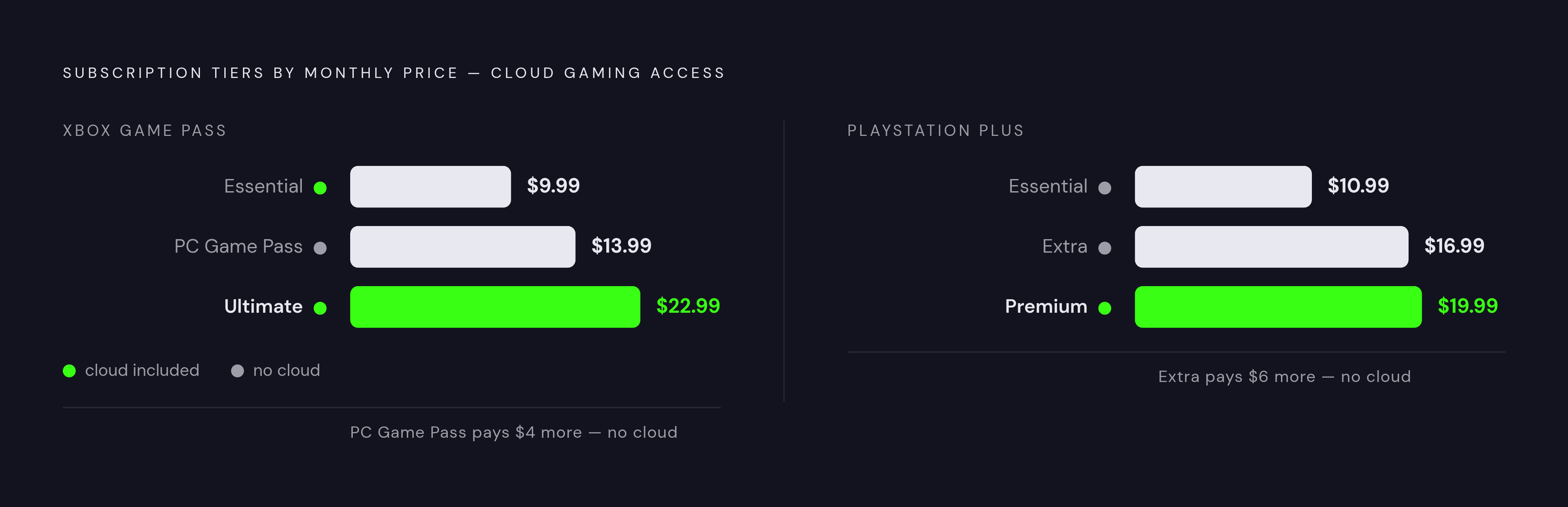
Game Pass Essential is $9.99/month and comes with 50+ games, online multiplayer and basic cloud gaming. For mobile players, the cloud access is the decisive inclusion, though it comes with the lowest monthly hour allocation. Entry-level does not mean console-only in this case. By contrast, PC Game Pass costs $13.99/month and offers day-one releases and EA Play, but no Xbox Cloud Gaming, so it does not solve the access problem for mobile-only players.
Game Pass Ultimate is $22.99/month and comes with 500+ games, day-one first-party releases, EA Play, Ubisoft+ Classics and Fortnite Crew. It also provides Xbox’s best available cloud quality and broadest cloud device support. This is the most complete package. Its value on a phone, however, rests on how much of that package the player can reach and use within the streaming allowance.
PlayStation Plus Essential is $10.99/month and comes with online multiplayer, games that rotate each month and cloud saves. It comes without a Game Catalog or cloud streaming. Extra, at $16.99/month, adds hundreds of downloadable PS4 and PS5 games and Ubisoft+ Classics, but still no cloud streaming.
Premium is $19.99/month and adds roughly 340 classics, game trials, streaming for some titles and the Sony Pictures Catalog. It is the only PlayStation Plus tier with cloud streaming, though that does not make its phone support equivalent to Ultimate’s. Billing also changes the comparison. Premium has an annual option, while Ultimate is billed monthly only, so the two monthly figures do not establish the full annual price gap.
How Xbox Cloud Gaming actually works on a phone, and the November 2026 hour cap that changes the math
On Android phones, players use Xbox Cloud Gaming through a web browser at xbox.com/play rather than a native cloud-gaming app downloaded from Google Play. On iPhone, the route is Safari, with the site added to the Home Screen for an app-like experience. The browser is the doorway in both cases. That distinction is worth preserving because the existence of an Xbox mobile app does not mean cloud games launch through a native app on every phone.
On mobile, streaming reaches up to 1080p/60fps. A minimum connection speed is required, with a higher speed recommended, but bandwidth is only part of the experience. Input delay remains the sensitive variable. A connection that feels playable for many genres can still make fast-action games less forgiving, so image quality alone is a poor measure of how well a cloud session works.
Feedback also differs by platform. The Android Xbox app supports controller rumble and haptics, while Safari on iPhone has limited support because it lacks the Gamepad Haptics API.
The November 2026 change introduces a different constraint. Ultimate’s 15-hour monthly cloud cap makes streaming time a budget, with additional hour packs available for players willing to pay for more. Before that change, unlimited streaming strengthened Xbox’s case as a replacement for console ownership. After it, a mobile-first subscriber must evaluate not just which games are included, but how much access the monthly payment actually buys.
That is the pivot in this comparison. A light player may fit comfortably within the allowance, while someone whose phone is the main gaming screen may find the meter more consequential than another catalog addition. Xbox still has the edge for play across devices under the cap. It changes the conditions under which that advantage is good value.
What PlayStation Plus actually offers mobile players, and where PS Remote Play fits in
PlayStation Plus Premium cloud streaming and PS Remote Play are separate services, and each has its own requirements. Premium’s cloud library includes titles such as God of War Ragnarök, The Last of Us Part I and The Last of Us Part II Remastered, plus classics. But a cloud listing is not a phone-access guarantee. Supported devices and regions limit the usable library, leaving PlayStation’s mobile streaming reach narrower than Xbox’s.
Remote Play takes a different route entirely. It streams from the player’s own PS5 to a phone rather than from Sony’s cloud servers, and it requires no PlayStation Plus subscription. The console must be powered on and connected at home. That requirement is substantial for someone without a PS5, but for an existing owner it turns hardware already purchased into a source of mobile play.
A March 2026 PlayStation Portal update added a higher-bitrate 1080p High Quality mode that reduces compression artifacts, but that Portal feature should not be presented as a phone upgrade. Remote Play added support for 3D Audio on devices that can use it in November 2025. DualSense haptic feedback, however, is not supported over Remote Play on either iOS or Android.
For a PS5 owner, the strongest benefit is simpler. Remote Play is free and has no hour cap, provided the home setup supports it. It also offers a native iOS app. After November 2026, those qualities make it a meaningful alternative to metered Xbox cloud play, though not a console-free substitute for it.
Game catalog differences that actually change what a mobile player can reach
Ultimate’s day-one first-party releases from Xbox Game Studios and Bethesda shorten the wait between a game’s launch and subscription access. That is attractive when the subscription is the player’s main route into new games. There is an important exception. Call of Duty day-one access was removed from Game Pass with the April 2026 pricing change, so “day one” should not be read as a universal promise.
PlayStation’s catalog works on a different timetable. Sony’s biggest new exclusives typically reach Extra 18–24 months after launch. From January 2026, PS4 additions to Monthly Games and the Game Catalog also became intermittent, reflecting the shift toward PS5-native content. Inclusion in a downloadable console library does not itself create cloud access on a phone.
Rotation adds another complication to that timetable. Short mobile sessions can stretch a playthrough across weeks, increasing the disruption when a game leaves the catalog before the player finishes it. Without a local copy to fall back on, access becomes the immediate obstacle. A large library is therefore less reassuring than it first appears if the player’s available time and the game’s availability do not align.
Genre and input support can be more useful than another hundred titles. On Android, Xbox Cloud Gaming offers touch controls for games including Minecraft Dungeons and Fortnite, giving players without a controller a practical way in. Even with touch support, some games work better for streaming than others. Fast-action titles remain more sensitive to delay, while shorter sessions can make a long playthrough harder to complete before rotation intervenes.
How a mobile controller shapes which service delivers on its promise
For most genres, streaming to a phone without a controller is a compromise. These are console-style games arriving on a smaller screen. The controller becomes the working interface. A subscription may deliver the picture successfully while still leaving the player with an awkward way to act on it.
Variable network latency already puts time between an input and what happens on screen, so precise controls and low-latency input help keep the controls from adding to that delay. Ergonomics belong in that calculation too. Holding a phone and a separate Bluetooth gamepad feels different from using a controller built for mobile play, especially away from a desk or couch.
Even with a controller, the service’s device restrictions, game departures and hour-bank limits remain in place. What it can do is make the games that are available more practical to play. That is why controller fit belongs in the subscription decision rather than appearing afterward as an optional flourish.
Which service is the clearer fit for mobile-first players, and under what conditions the answer flips
For a player without a PS5, Xbox Game Pass remains the better starting point. Its broader cloud reach, day-one first-party releases and touch-control support give a phone-first subscriber a more direct route to play. After November 2026, Ultimate is the better fit for people who play a light-to-moderate amount and stay under 15 cloud hours per month. They can use its main mobile strengths without making extra streaming time part of the regular bill.
Heavy use changes that recommendation. Daily sessions of more than 30 minutes can bring the monthly allowance into play, weakening Ultimate’s value unless the subscriber is willing to buy additional hour packs. The phone may be welcome, but the clock is running. For someone relying on cloud gaming as the primary way to play, that is a recurring cost condition.
For an existing PS5 owner with a suitable home setup, Remote Play can be the stronger unlimited mobile option. It requires neither a subscription nor an hour allowance, while Premium’s narrower device support makes it a less direct answer to phone-first cloud gaming. The choice turns on ownership and usage. Once those conditions are settled, the practical next step is to match the controller to the phone and the games, because access only becomes useful when the controls make it playable.