Legal ROM Sources and Digital Preservation for Mobile Emulation
Apple's policy shift legalized the emulator, but left the downloaded games in a legal gray zone.
Mobile emulation runs on a split most players never think to make: the emulator app is legal, and the ROM file loaded into it almost certainly is not. That gap sat unexamined for years, because emulation lived on the margins of mobile gaming, and it doesn't anymore.
Picture the ordinary path into this hobby in 2026: someone downloads Delta from the App Store, sees Apple's name attached to the download, and reasonably figures the whole enterprise has been cleared by somebody with a legal department. It doesn't, and untangling why is the whole point of this piece.
The emulator half of that equation has been settled law since before most Delta users were born. Sony Computer Entertainment Inc. v. a console manufacturer's emulator rival, decided by a federal appeals court, held directly that a game console emulator built through reverse engineering was a lawful product, made specifically to let software interoperate across platforms. That ruling came out of a pair of federal appellate decisions establishing the same basic principle, and neither has been overturned since. No statute passed in the intervening 26 years has changed the outcome. Emulator software, on its own, sits on solid legal ground.
The ROM is a different animal. Downloading a copy of a game from a random website means reproducing copyrighted software without authorization, which 17 U.S.C. § 106 reserves to the copyright holder. The emulator itself has no way to check whether the file a user feeds it was dumped legally from a cartridge they own or pulled from a server with zero rights to distribute it. It just runs the code. And because copyright terms stretch for decades, nearly every game a modern player wants to emulate, from 1980s Nintendo titles through the PlayStation 2 library, is still under active copyright protection. A game being old does nothing to move it into the public domain. Age and legality are unrelated facts that happen to look related.
What Apple's App Store opening changed
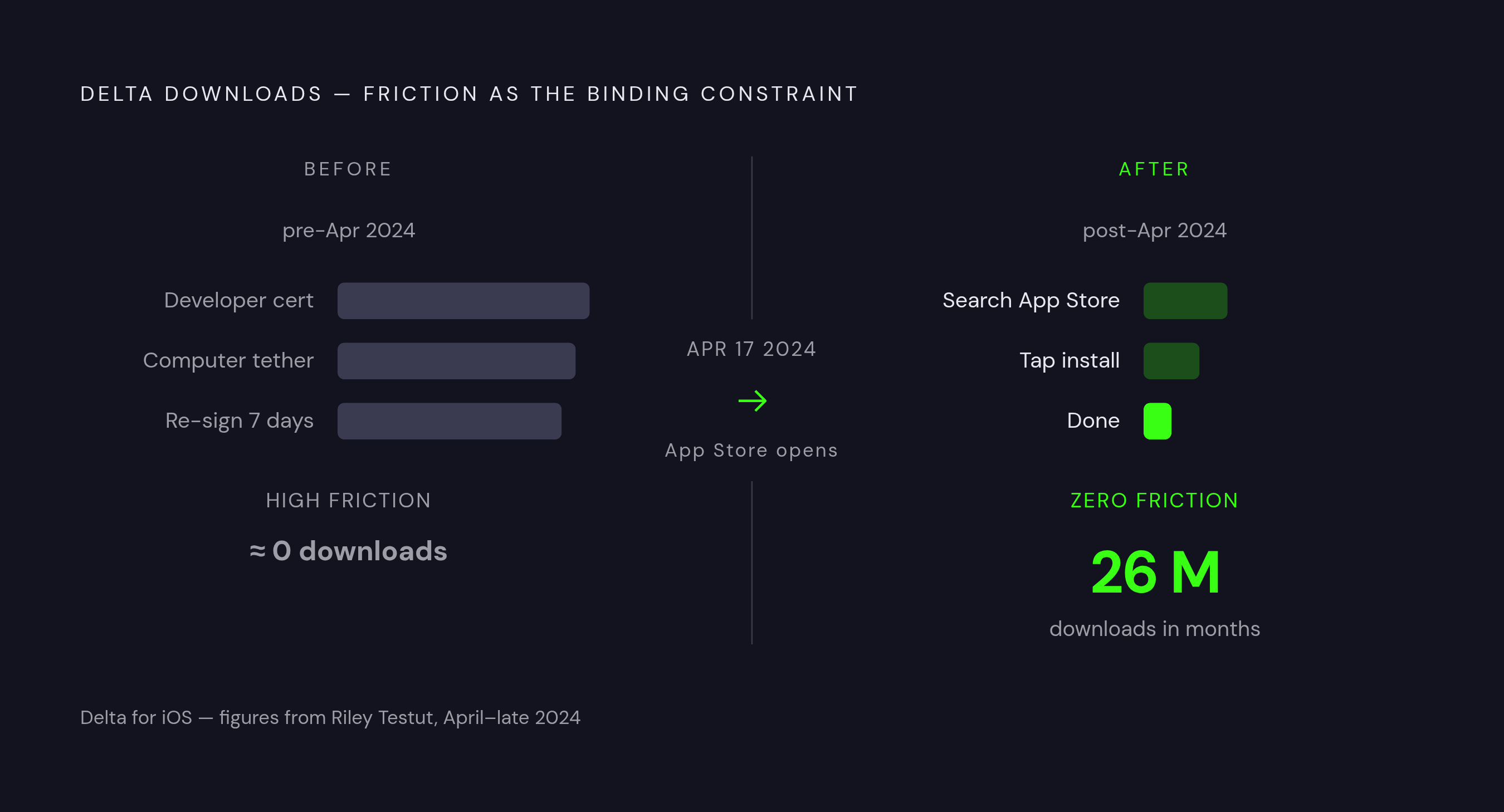
Apple's 2024 revision to its App Store guidelines on emulation counts as the single largest expansion of the emulation audience in the platform's history. Before that change, playing a classic console game on an iPhone meant sideloading, a process involving developer certificates, computer tethering, and enough friction to filter out anyone without real motivation. After the change, you could just open the App Store and tap install, the same three motions you'd use to install a weather app.
Delta, built by developer Riley Testut, turned into the clearest evidence of how much that friction mattered. The app handles NES, SNES, Nintendo 64, Game Boy, Game Boy Color, Game Boy Advance, and Nintendo DS in one interface, and it has logged over 26 million downloads since launching on the App Store on April 17, 2024. Those numbers put mobile emulation somewhere well past "niche hobby" and into mainstream gaming territory. A beta version, Delta 2.0, adds a redesigned "Liquid Glass" interface built for iOS 26, support for Sega Genesis, and RetroAchievements integration across every supported system, including GBC, GBA, DS, and Genesis.
Delta wasn't an isolated case either. PPSSPP followed it onto the App Store globally, and the door it opened stayed open for other projects, so it didn't close behind one app. PPSSPP itself adjusted its business model along the way, discontinuing its separate Gold app for iOS in favor of an in-app purchase.
What the policy shift didn't do matters as much as what it did. Apple authorized nothing about ROM files. Delta ships with zero games built in, and it tells users to supply their own authorized ROMs. An app's presence on the App Store signals that Apple's review process cleared the software, and nothing more. It grants no permission to go download a copyrighted ROM from an unauthorized site, no matter how official the emulator running it looks.
So the emulator side got radically easier and more visible almost overnight, but the ROM side stayed exactly where it had always been. The audience encountering that unchanged legal reality grew by tens of millions of people, many of whom never had reason to learn the distinction. More people reaching the App Store than ever before also means more people about to walk straight into unauthorized ROM downloads without any warning that the distinction exists.
Why the ROM side is genuinely risky
Nintendo's conduct between 2024 and 2026 shows that the risk on the ROM side is not abstract or theoretical. It has a casualty list.
In October 2024, Ryujinx, a major Nintendo Switch emulator, shut down after Nintendo's lawyers contacted its developer directly. That wasn't a one-off. By 2026, Nintendo had escalated to filing DMCA takedown notices against open-source forks of Switch emulation projects hosted on GitHub, targeting networks of repositories numbering well into the hundreds in single actions.
The legal mechanism behind this campaign deserves attention, because it doesn't rely on arguing that emulators are illegal, a fight Nintendo would likely lose given Sony v. Connectix. Instead, Nintendo leans on the DMCA's anti-circumvention provisions. Playing a Switch game requires decrypting Nintendo's encryption first, and circumventing that protection is precisely what the DMCA prohibits, regardless of whether the emulator software itself would otherwise pass legal muster. So Nintendo can go after projects, forks, mirrors, and the sites linking to them, and it never has to litigate the broader question of emulator legality in open court. It's narrow, but it works.
The fallout spreads further than the specific repositories targeted. When GitHub projects face takedown notices at this volume, developers doing legitimate preservation work, cataloguing old hardware behavior, documenting console architecture, building tools with no piracy angle at all, pull back too, wary of becoming the next name on a notice. That chilling effect costs the preservation side of this story real contributors, not just the circumvention-tool side.
Nintendo's current enforcement focus sits on Switch-era circumvention tools specifically, not on emulation of older systems like the NES or SNES. But the legal machinery built to go after Yuzu and Ryujinx forks doesn't disappear once this particular fight ends. It exists now, tested in practice, ready to point somewhere else if a rights holder decides to. The practical risk facing an ordinary player in 2026 isn't running an emulator on an iPhone but distributing or depending on circumvention tools and pirated ROM files, the exact activity Nintendo has shown it will pursue.
The narrow band of genuinely legal ROM sources that exists today
Legal ROM access exists, but it's narrower than most players assume. It breaks into a few distinct categories, separated out below rather than lumped together under one vague "it's probably fine" umbrella.
If you own the physical media, self-dumping gives you the clearest and most defensible route for commercial games. This means using dedicated hardware to extract the game data straight from a cartridge or disc sitting on a shelf. The sources on this point name specific tools: the Retrode 2, the INLretro Dumper (previously known as the Kazzo), and assorted homebrew apps built for cartridge ripping. For disc-based systems like the PS1, BIOS files follow the identical logic: the legal path is dumping your own console's BIOS rather than downloading someone else's copy off a forum. The legal footing for personal backups is debated and varies depending on jurisdiction, so this counts as the lowest-risk path for personal use rather than a guaranteed safe harbor with a court ruling behind every case.
Homebrew releases, public domain titles, and developer-approved freeware make up a second, cleaner category. MAME's official page for free-download ROMs hosts arcade games their original creators released for free use, and it stands as one of the clearest examples of an emulator project drawing a hard line between its own software and the game files people run on it. These sources are clean because the rights holder affirmatively authorized distribution, not because enough time has passed that nobody seems to mind anymore.
Commercial re-releases round out the legal map. A storefront for PC-era titles sells copy-protection-free versions bundled with original game files, preconfigured to run in a software emulator, so PC gaming gets a clean commercial route that console titles don't have in quite the same form. Nintendo Switch Online and PlayStation Plus Premium take a different approach entirely: they stream original game code from servers the rights holder controls directly. Both are fully licensed, with the tradeoff that library selection and modding options stay limited compared to what a self-dumped or homebrew collection allows.
Evaluating any ROM source, legal status aside, comes down to a few checks. Does the source provide CRC32 or cryptographic hashes so a file's authenticity can actually be confirmed? Verification standards from groups like No-Intro, Redump, or TOSEC signal a clean, unmodified dump. Community vetting on forums like r/emulation, r/Roms, or GBAtemp carries a track record that's worth paying attention to. Red flags run the other direction: a requirement to install some "special downloader" app before getting to the actual file, ROMs wrapped inside.exe installers, zero community reputation behind the source, or current-generation content hosted openly.
One misconception deserves direct correction, because it trips up even players trying to do this responsibly. Nintendo states explicitly that if you download or upload unauthorized copies, that's illegal even if you own the original cartridge. Buying a copy of a game in 1995 bought a physical object and the right to play it on that hardware. You owned the cartridge the whole time, but that didn't buy you a standing license to download a digital copy from the internet three decades later, however intuitive that connection might feel.
How the preservation crisis strains the legal framework
The strongest challenge to this entire legal framework doesn't come from people who try to pirate games. It comes from institutions trying to save them before they disappear for good.
Research from the Video Game History Foundation found that a large majority of video games released in the US before 2010 have been lost already or sit at serious risk of being lost. It's a preservation gap at the scale of an entire medium's early decades, far beyond a rounding error or an edge case affecting a handful of obscure titles.
The Internet Archive, one of the largest digital preservation libraries online, has used MAME to make arcade games playable directly through a browser, framing this as part of its broader historical mission. Its legal exposure for doing so remains ongoing and unresolved. The Video Game History Foundation's own digital archive launched in Early Access, so anyone who studies the medium's history can access it free worldwide. Yet the VGHF itself acknowledges that it "cannot give express permission" for users to reproduce materials in that library unless explicitly stated otherwise, a striking admission of how tightly copyright constrains even a credentialed nonprofit built specifically for preservation.
Rights holders have a response to this, and it isn't unreasonable on its face. Official re-release channels already exist, Nintendo Switch Online and PlayStation Plus Premium chief among them, and publishers argue that broad legal exemptions for preservation would undercut the revenue those channels generate. The US Copyright Office's 2024 decision reflects that position. What results is a genuine structural stalemate: protecting intellectual property and preserving gaming history as a cultural record pull in different directions, and current law hasn't found a clean way to satisfy both at once. That tension is why the alternatives below matter as much as they do.
Cloud gaming as the structurally cleanest path for modern titles on mobile
For a player who wants to play a modern or recent title on a phone without wading into any of the ROM questions above, cloud gaming sidesteps the entire problem by restructuring who holds the files. The rights holder keeps the game on its own servers, the player streams video and sends inputs back, so no ROM ever touches the player's device. There's nothing to source, verify, or worry about dumping, because there's no local file in the equation to begin with.
The field has settled, as of October 2026, around five major services: NVIDIA GeForce Now, Xbox Cloud Gaming, PlayStation Plus Premium, Amazon Luna, and Boosteroid. NVIDIA GeForce Now Ultimate, priced at $19.99 a month, stands out as the best overall cloud gaming service as of October 2026, running games on RTX 5080-class servers at high resolutions. Shadow takes a structurally different approach from the rest of the field: rather than streaming individual games through a curated interface, it rents out a persistent Windows 11 desktop in the cloud, letting a subscriber install Steam, Epic, Battle.net, or any other platform they'd normally run on a home PC. That makes it the closest thing to a genuine "play anything" service among the group, positioned at the highest price point to match.
Cloud gaming removes the ROM issue from the table entirely if you're willing to stream rather than own a local copy, so it won't touch an old SNES cartridge sitting in a drawer, and it won't solve the preservation gap the Video Game History Foundation has documented. But for modern titles, it offers something the ROM side of this whole conversation can't: a way to play on a phone where the legal status of the file was never in question, because there was never a file on the phone to begin with.