Emulation vs Official Retro Collections on Mobile
iPhone and Android players can now choose between free emulators and licensed collections.
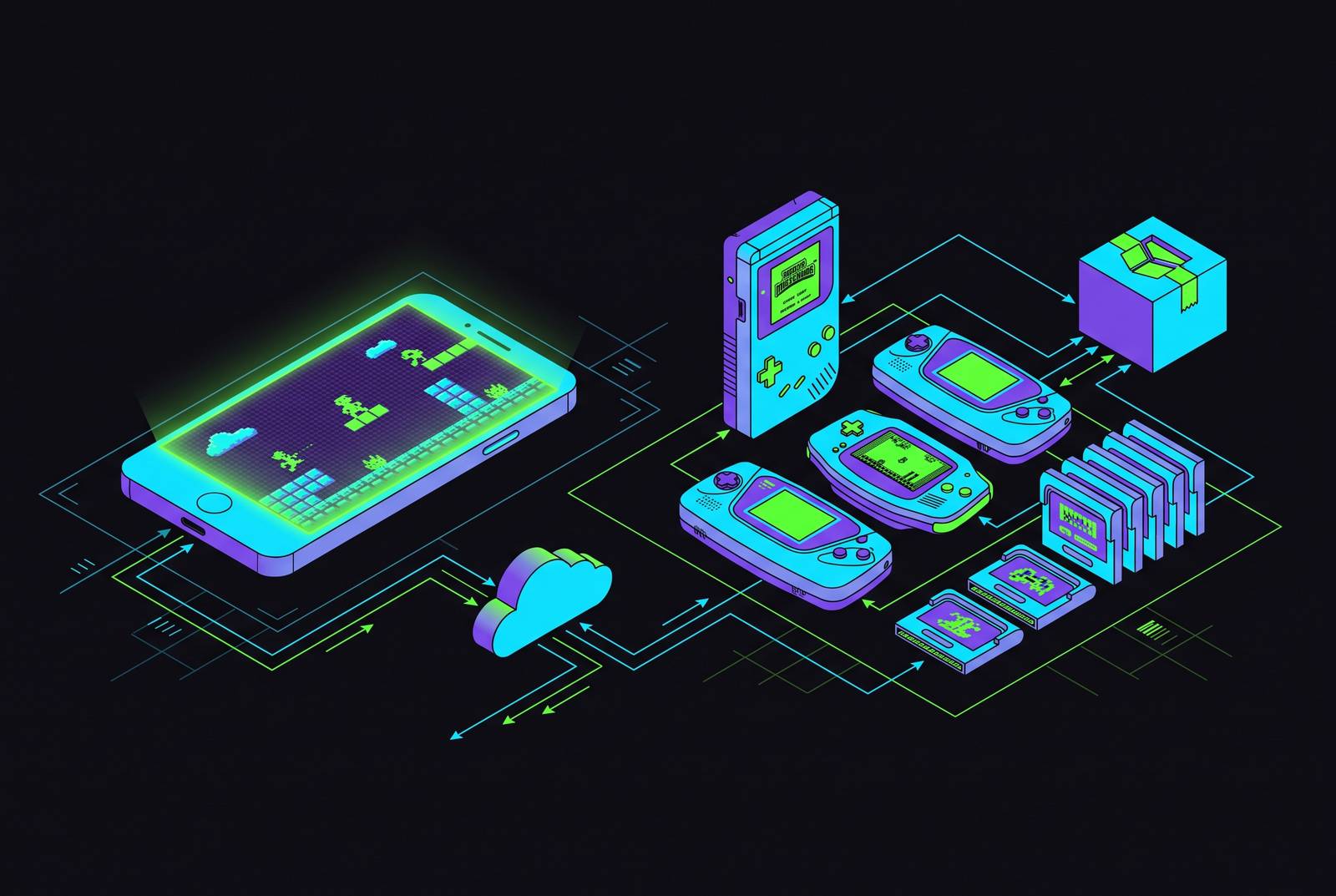
A phone in a player's pocket is now a more capable retro gaming machine than most dedicated hardware sold a decade ago, and the decision about how to use it is a real one rather than something forced by weak processors or locked-down app stores. Apple's formal policy reversal, which opened the App Store to real emulators, closed a gap that had defined mobile gaming for years: Android had always tolerated this kind of software, while iOS had not. That change means a player no longer needs a jailbreak or a sideloading workaround to get an emulator running. Downloading one now takes the same two taps as downloading anything else from the App Store, sitting right next to the official game apps it competes with. Anyone picking up mobile retro gaming today has to choose between two distinct paths on purpose, and that choice carries more weight than it first appears.
What emulation on mobile gives you
Emulation's main selling point is coverage: one app, installed for free, can reach back across nearly the entire history of console gaming. On Android, RetroArch acts as a single frontend for systems spanning the NES and Game Boy era all the way through PlayStation 1 and Nintendo DS, with Nintendo 3DS games running through the Azahar core (PS2 emulation isn't available on Android, a real ceiling on that breadth). On iOS, Delta covers the Nintendo side of that same history in one app, NES, SNES, Game Boy, GBC, GBA, Nintendo DS, and N64, and it's free with optional paid features on top.
An emulator is just an engine, and it needs a ROM file to actually run anything. The emulator software itself is legal. What a player does to get the ROM determines its legal status, which depends on how it was obtained. That distinction matters enough that the preservation section below returns to it, but the short version is that breadth on paper doesn't mean breadth without effort or without risk.
Setup carries a front-loaded cost. Emulators need configuring: picking the right core for a system, matching aspect ratio to a modern screen that was never designed for a 4:3 picture, remapping buttons that were built for a d-pad onto a glass surface with no physical feedback. None of this is a dealbreaker, but none of it is instant either, and a player expecting a tap-and-play experience will find something closer to light systems administration. A physical controller restores real sticks and triggers, giving back the kind of precision a touch overlay simply can't fake for games engineered around physical buttons, which is part of why mobile controllers like Backbone's are built specifically to pair with emulators and hand back the tactile response those games were designed to expect.
What official retro collections on mobile give you
Official collections start from the opposite assumption: rather than maximizing coverage, they maximize certainty. Nintendo added GameCube games to its library alongside the Nintendo Switch 2 launch on June 5, 2025, and those titles are exclusive to Switch 2 hardware, a reminder that even official access can be gated by which console a player owns. What a player gives up in scope, they get back in features that emulators rarely offer out of the box: suspend points, rewind, adjustable controls, and online multiplayer that actually works as intended, all of which run even better when paired with a dedicated mobile controller built for the longer sessions retro gaming tends to invite.
Evercade offers a different version of the official model entirely, one built on physical cartridges rather than subscriptions. Its library draws from publishers including Atari, Taito, Data East, Toaplan, Mega Cat Studios, and Piko Interactive, and spans more than 80 cartridges covering over 750 games. The current flagship handheld, the Evercade EXP-R, runs a 4.3-inch IPS screen with built-in WiFi and a TATE mode for vertical arcade games, and ships bundled with the Tomb Raider Collection. A new flagship, the Evercade Nexus, is expected in October 2026 with a 5.89-inch screen, dual analogue sticks, and WiFi 6, bundled with a Banjo-Kazooie Double Pack cartridge carrying customized versions of Banjo-Kazooie and Banjo-Tooie (a DOOM Edition is also available), and pre-orders for it have already sold out.
Everything on it is licensed, and nothing on it came from anywhere else. That's a real trade, not a limitation by accident: a player plugs in a cartridge and plays, with zero setup and zero legal ambiguity, a genuine advantage for anyone who finds the emulation setup process more hassle than it's worth. What it costs that player is choice.
The preservation gap that neither path fully closes
That licensing logic runs into a larger problem neither path solves on its own. The Video Game History Foundation has found that a large share of classic video games are critically endangered, with only a small fraction of gaming history represented anywhere in the current commercial market. It means most of what was made for most consoles in most decades isn't for sale, through Nintendo's apps, through Evercade, or through any other official channel.
Emulation communities point to that figure as moral cover for playing games outside official channels, arguing that when a title isn't commercially available anywhere, an emulator may be the only way it survives. The argument has real force for the games it actually describes, but it proves too much when applied broadly: most people running an emulator are playing games they never bought, not rescuing titles from disappearance. The practical question for a player to ask is narrower than the ethical debate suggests. If the game is sitting in an official library already, the preservation argument doesn't apply to that case. If it isn't, which is statistically the more likely outcome for anything older or more obscure, emulation may be the only route to it that exists.
Where emulation wins, where it costs you
Weighed directly against official collections, emulation wins cleanly on selection. It wins on cost in the same straightforward way: the software is free, and the only real hardware expense is a phone the player already owns, plus a controller if they want one.
Latency and setup time are what it asks for in return. Bluetooth controllers and the processing pipeline inside an emulator both add delay, and that delay matters most in action games, fighting games, and rhythm games, where a few dozen milliseconds separates a clean hit from a missed one. Wiring the controller directly into the phone's port removes one of those latency sources. This is where hardware like the Backbone One becomes directly useful: a controller connected through the port rather than over a wireless radio takes the Bluetooth variable out of the equation for players where timing actually decides outcomes. Setup itself takes real time too: picking the right emulator for the system a player wants, finding ROM files through legal means, getting the display and controls configured correctly. RetroArch covers more systems than almost anything else available but asks more of a new user to learn it; Delta trades some of that breadth for a simpler experience focused on Nintendo systems. Which one is right depends entirely on what a player actually wants to sit down and play.
Where official collections win, where they fall short
Official collections win on the opposite axis: friction. Evercade is plug-in-and-play by design, and Nintendo's apps open straight into a game with no setup required. They also win on the features that make long sessions comfortable: suspend points, rewind, adjustable controls, legitimate online multiplayer, all built in rather than stitched together through community patches, and all of it works more smoothly paired with a controller built for extended handheld play. Legal standing is the clearest win of all: every title in an official library is fully licensed, so there's no question hanging over whether a player is allowed to have it.
Selection shows the limits most clearly: Nintendo adds GameCube titles irregularly, and as of August 2026 only ten are available, a number that reflects what could be licensed rather than any attempt at covering the format comprehensively. Cost isn't absent either, it's just structured differently than emulation's cost. Evercade devices and cartridges carry upfront prices, and Nintendo Switch Online runs on an ongoing subscription, so a player paying for either path is paying in a different currency than an emulation user. The subscription model adds a second risk beyond price: Nintendo's library stays accessible only while the subscription is active, and offline play even requires a weekly internet check-in. If the subscription lapses, the library goes with it. A player chasing one specific title that no official library carries has no official path to it, and given how much of gaming history sits outside those libraries, that situation is common.
Cloud gaming and remote play as a third path worth considering
Streaming sidesteps a lot of what makes both of the main paths complicated, though it introduces a dependency of its own: a steady internet connection, and in one case, hardware a player already needs to own. PlayStation Remote Play streams a game straight from a player's own PS5, the most practical mobile option for anyone who already owns the console. Its limitation is tied to that same ownership: the PS5 has to be powered on or in rest mode at home, and if the power goes out or someone else is using the console, the connection drops.
The controller argument that applies to emulation applies here with equal force, maybe more so, since streaming already introduces some network delay before a controller adds any of its own. A touch overlay is a poor match for the precision these games demand, and a direct-connect controller removes one more source of lag from a chain that already has enough of it; the Backbone One's wired design is particularly relevant in this scenario for exactly that reason. The lines between categories are already blurring at the hardware level: Android-based handhelds like the Retroid Pocket line run emulators and native streaming apps including Xbox Cloud Gaming and GeForce NOW side by side, treating emulation and cloud access as two settings on the same device. None of this replaces either main path for a player focused on retro libraries specifically. It's a genuine option for a player whose interests run past retro into current titles too.
How to choose based on how you game
Three questions settle this more reliably than any general verdict could: what games a player actually wants, how much setup time they're willing to spend, and whether legal certainty matters enough to trade for narrower selection. A player chasing one specific older or obscure title that no official library carries doesn't have much of a decision to make, emulation is the only real route there, and the setup time is justified by the absence of any alternative. A player already invested in Nintendo hardware gets the broadest official Nintendo library at the lowest marginal cost through Nintendo Switch Online, provided they go in understanding the subscription dependency and the slow, irregular pace of additions. A player who splits time between retro titles and current releases can build a setup around a phone and a controller that covers both: the retro side filled by emulation or an Evercade cartridge, the current-games side filled by Xbox Cloud or PS Remote Play.
The controller affects precision and responsiveness enough to change how a game feels before most players expect it to. Games built around physical buttons, sticks, and triggers don't translate cleanly onto a flat sheet of glass no matter which access model delivers them. A Backbone One, connecting directly through the phone's port rather than over Bluetooth, is the most relevant upgrade for a player on the emulation path who finds touch controls or wireless lag getting in the way, and the same wired advantage carries over to cloud gaming and remote play, where network delay is already a given and cutting out controller latency is one of the few variables a player can actually control. No single path wins across the board. Emulation offers the most games, official collections offer the least friction, cloud gaming offers the broadest current-title library, and the right combination depends on how a given player actually spends their time, not on which option happens to be loudest about being the answer.