Performance Benchmarks for Emulation on Current Android Flagships
Emulation performance hinges on chip architecture, not phone price or release date.
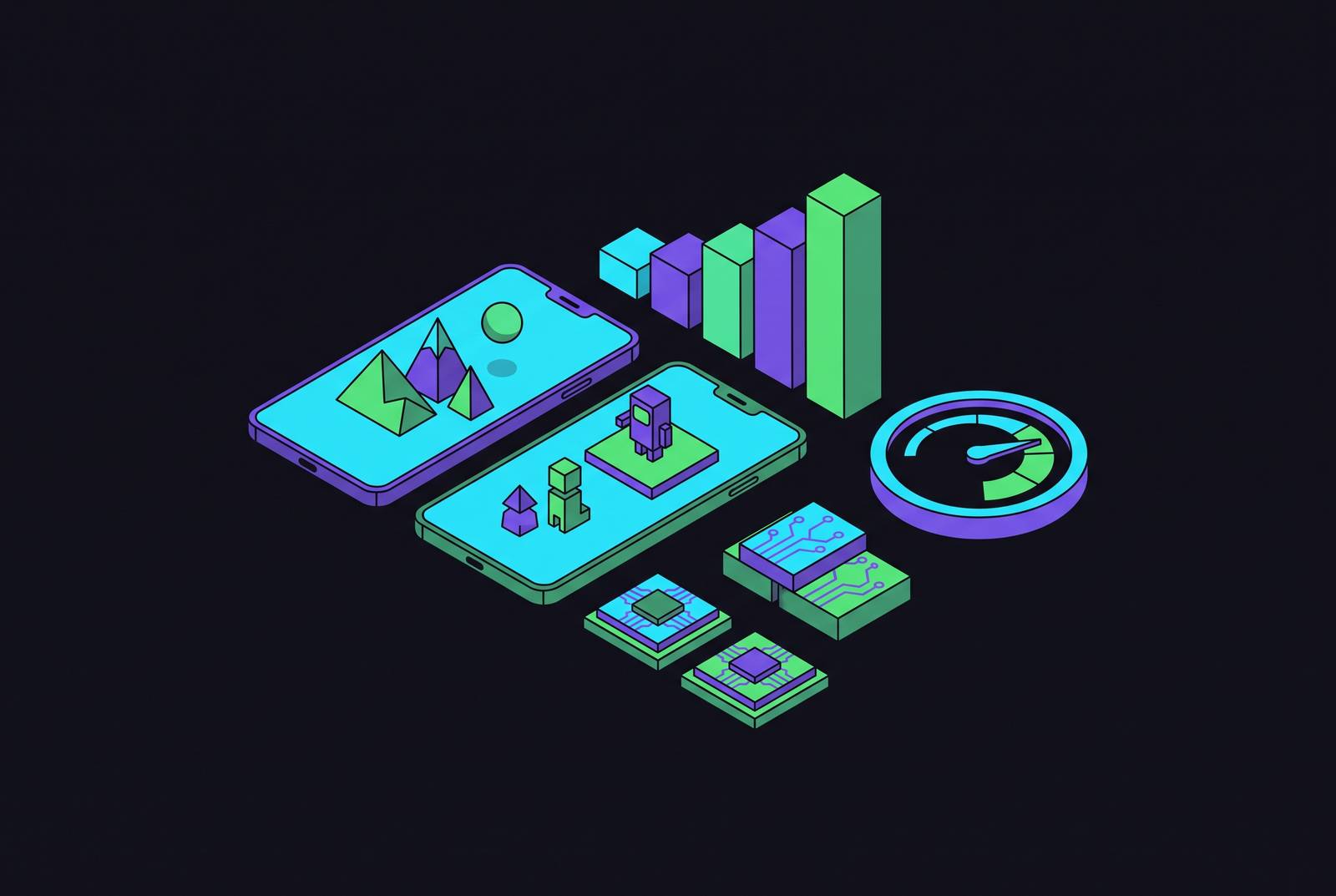
Native gaming on a current Android flagship will tell you almost nothing about how it handles emulation. Running a licensed, Android-optimized title on a Snapdragon 8 Gen 2 phone and an 8 Elite phone side by side mostly erases the differences: both push high frame rates, both look sharp, both feel fast enough that the gap seems academic. Emulation is where that illusion falls apart, because it's the one workload that asks a phone's processor to do something it was never built to do gracefully: recreate another company's console hardware in software, instruction by instruction, in real time. That demand exposes a split that price tags and marketing copy paper over. Two phones can cost roughly the same in 2026 and still land in completely different emulation tiers, because the chip architecture inside, not the brand on the back or the number on the sticker, decides the outcome. What sits inside is one generation of chip architecture or another, and that chip was built around Qualcomm's newer Oryon cores or an older Cortex-A design.
That single fact upends the usual shortcuts people use to pick a phone. "Flagship" doesn't mean "best at emulation." Newest" doesn't automatically mean "fastest at reproducing a modern handheld console. And "most expensive" tells you nothing about whether a device can hold a stable frame rate in a demanding open-world Switch title. The rest of this piece works through why that's true, what it means for specific consoles and specific devices, and where the picture gets messier than a simple "newer chip wins" story would suggest.
Oryon cores versus Cortex-A designs: why single-threaded performance is the bottleneck
The mechanism behind the split comes down to one number: single-threaded performance, how fast a single CPU core can execute instructions in sequence. Qualcomm builds the Snapdragon 8 Elite's CPU in-house as a custom design called Oryon, rather than licensing the standard architecture blueprints that power the 8 Gen 2 and 8 Gen 3. Oryon delivers substantially higher single-threaded performance than those older Cortex-A designs, and that specific metric, not total core count, not GPU power, not RAM, turns out to be the main thing holding back demanding emulation.
Why single-threaded speed specifically? Emulating a console means translating its instructions into something the phone's chip can run, and a large share of that translation work can't be split across multiple cores the way a modern game engine can. One core carries most of the load. A phone can have eight cores sitting mostly idle and still choke on a demanding emulation target, because that one core needs to be fast enough to keep up.
Switch emulation is hardest to run well because the console itself runs a comparatively complex, modern architecture that current emulators have to reconstruct almost entirely in real time. A chip can handle PS2 or GameCube games without breaking a sweat and still stumble on a demanding first-party Switch title, because Switch emulation needs much more from that one core. That's the divide: Cortex-A chips in the 8 Gen 2 and 8 Gen 3 handle lighter emulation targets well, but they hit a ceiling once the target gets demanding enough, and Switch is where that ceiling becomes visible.
A console-generation map from PS2 through Switch and into PC titles
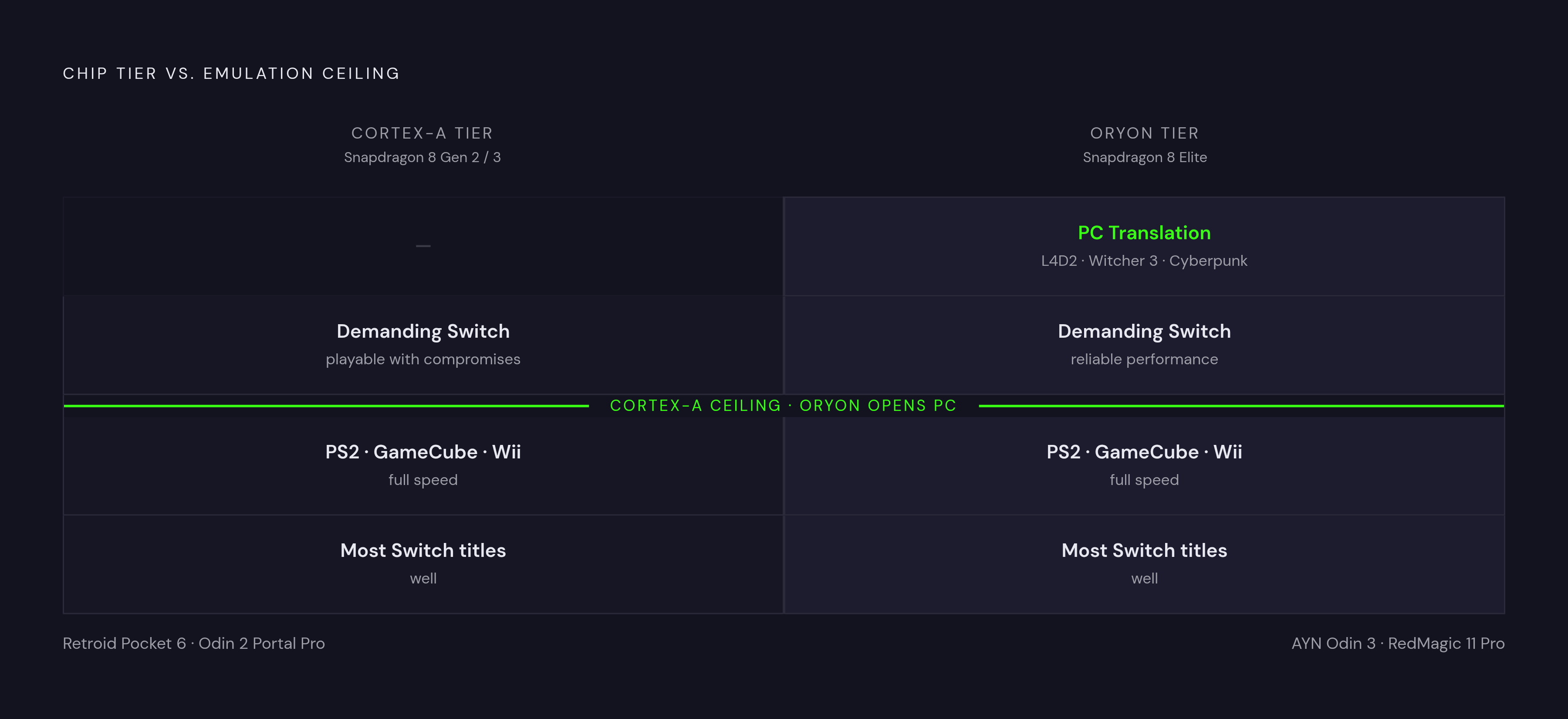
Laid out as a map, the two tiers draw a fairly clean line through the console generations most people actually want to play.
Cortex-A tier (Snapdragon 8 Gen 2 and 8 Gen 3):
This tier handles the console generations below Switch without much drama. PS2 emulation runs well across the board. GameCube emulation through Dolphin runs at full speed on 8 Gen 2 hardware for nearly the entire library, and most Wii titles are also fully playable, with only a small number of especially demanding games needing a resolution adjustment to stay smooth. Reach into the Switch library and the bulk of Switch games run well on this tier, but the most demanding titles, particularly sprawling first-party open-world games, land in "playable with compromises" territory.
Oryon tier (Snapdragon 8 Elite and 8 Elite Gen 5, represented by devices like the AYN Odin 3 and RedMagic 11 Pro):
This tier takes the same demanding Switch titles that strain Cortex-A hardware and moves them from "playable with compromises" to reliable performance. That alone would be a meaningful upgrade for anyone chasing full Switch library coverage. The bigger shift is what opens up past Switch entirely: PC game translation layers like GameHub, GameNative, and Winlator become genuinely viable. Tom's Hardware documented YouTuber ETA Prime running Left 4 Dead 2, Marvel Cosmic Invasion, the DX9 version of The Witcher 3, and Cyberpunk 2077 at playable frame rates on the AYN Odin 3, a Snapdragon 8 Elite device with 16GB of RAM. You're not emulating a console anymore; you're running PC games built for a desktop operating system on a phone, translated on the fly.
So the console-generation map isn't a straight ladder where each tier climbs one rung higher: Cortex-A opens the door through most of Switch, and Oryon opens a second door past Switch into PC gaming.
The Vulkan driver problem: why the newer architecture doesn't always win in practice today
The part of the story that complicates the clean "Oryon wins" conclusion deserves serious attention. Raw chip architecture is only half the equation. The Vulkan graphics driver, which translates emulator instructions into something the phone's GPU can actually render, hasn't caught up to the newer hardware as of mid-2026.
The Adreno 830 GPU paired with the Snapdragon 8 Elite and the Adreno 840 paired with the 8 Elite Gen 5 are still new territory for driver developers. Driver optimization for these chips lags behind what already exists for the Adreno 740 found in the 8 Gen 2, which has had years of refinement behind it. Community-built Turnip Vulkan drivers for the Adreno 740 trace back to initial support merged into Mesa in late 2023, and developers spent late 2023 through 2025 tuning that specific architecture, so by 2026 successive Mesa releases had resolved the issues.
That maturity gap produces a counterintuitive result: for demanding Switch open-world titles right now, an 8 Gen 2 device running on a well-tuned driver can match or even slightly outperform an 8 Elite device, despite the 8 Elite's higher theoretical ceiling. That raises a reasonable objection: if the older chip keeps pace with the newer one, the architecture argument still matters for a different reason. This is a temporary state of the software, not a permanent reversal of the hardware. The 8 Elite's ceiling is higher by design. What's missing isn't horsepower, it's years of driver tuning that the Adreno 740 already banked and the Adreno 830 and 840 haven't yet.
The incoming Turnip driver for Adreno 8xx
An open-source Turnip Vulkan driver is currently in development for Qualcomm's Adreno 8xx GPU family, the same open-source driver effort that already transformed Switch emulation performance on the Adreno 740 over its multi-year development arc. Once it reaches a similar level of maturity for the 8xx series, the expected result is a combination of bug fixes and real, measurable emulation performance gains across both the 8 Elite and the 8 Elite Gen 5.
That timeline matters for anyone weighing a purchase right now. If a device already runs the Switch library well on 8 Gen 2 hardware, something like a Retroid Pocket 6 or an Odin 2 Portal Pro, you have little reason to replace it in the near term. The 8 Elite's architectural advantage is expected to become clearly visible by around the fourth quarter of 2026, as driver support catches up to the hardware it's running on. If you buy an 8 Elite device today for Switch emulation alone, you pay for a ceiling that the current driver hasn't let the chip reach yet.
But if you're buying new in late 2026 rather than deciding whether to replace something that already works, the calculation changes for you. For that buyer, Oryon-based hardware is the forward-looking choice, because the driver gap is a temporary condition of 2026 while the hardware headroom built into the 8 Elite and 8 Elite Gen 5 is permanent. If you buy the chip with the higher ceiling now, the device keeps improving on its own, through driver updates, long after the purchase, without any new hardware involved.
The thermal ceiling on Oryon: what PC game emulation costs in power and heat
When Oryon hardware unlocks PC game translation, you pay for it in watts and degrees, not dollars. Running Cyberpunk 2077 or The Witcher 3 through a translation layer on a phone-class chip is a genuinely demanding workload, and peak power draw during that kind of session creates a real thermal and battery constraint. A phone pushing a PC game through Winlator or GameHub at playable frame rates is working near the top of what its silicon and its cooling can sustain, and that limits both session length and the form factors where the experience holds up.
The picture looks different once the workload gets lighter. That's an important distinction to hold onto: the thermal ceiling isn't a property of Oryon chips generally, it's specific to the PC translation use case running at maximum load. Switch emulation and anything from older console generations stay well within a manageable power budget on this tier. The heat appears only at the far edge of what the hardware can do, not across the whole emulation library.
Named devices in each tier
Mapped onto real products, the tier argument holds up cleanly. The AYN Odin 3 and the RedMagic 11 Pro both are in the Oryon tier, built around the Snapdragon 8 Elite Gen 5 in the RedMagic's case, with the RedMagic offering configurations up to 24GB of RAM and a cooling system built around a liquid cooling loop paired with a 24,000 RPM turbo fan, backed by a 7,500mAh battery. That cooling setup is directly relevant to the thermal discussion above: a device pushing PC game translation layers needs exactly this kind of active cooling to sustain performance and avoid throttling.
On the Cortex-A side, devices like the Retroid Pocket 6 and the Odin 2 Portal Pro give you mature, well-supported hardware running the 8 Gen 2 or equivalent silicon. These devices benefit from the years of driver tuning described earlier, and for Switch emulation covering the majority of the library, they remain a strong value choice in 2026. The upgrade case against them is weak for most of the Switch catalog, precisely because driver maturity hasn't yet shifted the practical advantage to the newer chips. None of this is a ranking of better or worse devices in some absolute sense. It's a map of which tier each device sits in and what that tier is built to do.
Where a physical controller changes the emulation experience
Chip architecture decides whether a game runs. Input decides whether a game is actually fun to play, and no amount of CPU or GPU horsepower solves that. Even if you have the most capable Oryon-based phone, you still platform-jump or aim with your thumbs smearing across a pane of glass if you want a rock-solid frame rate in a demanding Switch title. Touch controls are a real limitation on every tier, and a physical controller finishes the job the chipset started.
This is part of why dedicated Android gaming handhelds dominate emulation discussions the way they do. The Odin 3 and the Retroid Pocket 6 both build physical controls directly into the device, so the chipset's capability and the input method arrive as a single package rather than something the user has to assemble separately. Standard Android flagship phones, a Galaxy S26 Ultra or a OnePlus 15, for instance, carry the exact same chipset capability as their handheld counterparts, but they need an external controller bolted on to deliver a comparable experience. The silicon inside a flagship phone isn't the limiting factor there. The limiting factor is that nobody wants to drag a Switch's worth of platforming across a touchscreen.
For someone who already owns a capable flagship, whether it's running Oryon or 8 Gen 2 silicon, and has no interest in buying a second, dedicated handheld, a clip-on controller that connects directly to the phone closes most of that gap. It won't turn a phone into a Retroid Pocket 6, but it brings the input experience close enough that the phone's existing chipset, which is often perfectly capable, finally gets to show what it can do.
Reading your own device against the tier map to decide whether an upgrade makes sense now
Place a current device against everything above and the upgrade decision mostly answers itself. Anyone running an 8 Gen 2 or 8 Gen 3 chip, whether in a Retroid Pocket 6, an Odin 2 Portal Pro, or a standard flagship phone, already has a device that plays most of the Switch library and the entire PS2 catalog well. For the most demanding Switch titles specifically, that device's driver support is mature enough that it may outperform a newer 8 Elite phone right now, in mid-2026. Replacing that hardware becomes worthwhile starting in the fourth quarter of 2026 at the earliest, when Turnip driver support for the Adreno 8xx family is expected to mature and the 8 Elite's architectural lead becomes something a player can actually feel on a spec sheet.
Buying new changes the calculation. For anyone purchasing a device in late 2026 rather than deciding whether to replace one, Oryon-based hardware, the Snapdragon 8 Elite or 8 Elite Gen 5, is the sounder long-term foundation, because the driver gap is closing while the hardware ceiling stays fixed and high. If the primary goal is just Switch and older systems, the practical difference between tiers today is smaller than raw benchmark numbers suggest, but the direction the platform is heading, deeper PC translation support, higher internal rendering resolutions, whatever console target comes after Switch, lives on 8 Elite hardware. For PC game translation specifically through GameHub, GameNative, or Winlator, Oryon isn't a preference, it's a requirement; Cortex-A hardware simply can't sustain that workload.
Anyone reading this against a phone already in their pocket rather than a dedicated handheld should run one last check. Check which chipset it carries. An 8 Elite or 8 Elite Gen 5 means the hardware is already there, and the only piece missing is a physical controller to actually use it. An 8 Gen 2 or 8 Gen 3 means a genuinely capable emulation device exists in that pocket right now, ready for PS2, GameCube, Wii, and most of the Switch library, with no upgrade required until the driver landscape itself changes.