Legal ROM Sourcing and Emulation Law Basics for Mobile Players
Emulators are legal, but the ROMs you run on them might not be.
You have the phone in your pocket. You have the emulator installed. The question that follows is not whether emulation is legal, because that question has been settled for more than twenty years. The question is where the files come from, and whether the answer to that question survives contact with the law.
Why the emulator-versus-ROM distinction is the only legal question that matters for mobile players
Most players treat emulation as one activity, as though downloading an emulator and downloading a game for it were the same kind of act. They are not. The law draws a clean line between the software that mimics console hardware and the game files you run on it, and the source of nearly every legal risk in retro gaming sits on one side of that line. An emulator, built the right way, is legal software. A ROM downloaded from a website is an infringing copy of a copyrighted game. These are two legally separate acts that happen to occur together, and the confusion comes from treating them as inseparable.
The practical consequence is that a mobile player can make every downstream decision confidently by understanding where the risk lives. The emulator is not the problem. The ROM is the problem, and specifically the question of where you got it. If you can answer that question cleanly, the rest of the framework is almost mechanical.
Why emulators themselves have been consistently legal for over two decades
Two federal court rulings established the legal foundation for console emulation, and no statute or subsequent ruling has overturned it. The first came in 1992 in Sega v. Accolade, when the Ninth Circuit held that reverse engineering a console to achieve interoperability with its software is fair use, even when the analysis phase requires temporarily copying protected code. The second arrived in 2000 in *Sony Computer Entertainment v.
The operative word in that history is "clean." An emulator built by observing how a console behaves and then writing original code to replicate that behavior does not copy proprietary software. The emulators most players know, Dolphin, PPSSPP, PCSX2, and DuckStation, were built this way. RetroArch is a separate case worth noting, since it is a frontend that runs emulator cores rather than an emulator itself, but it rests on the same underlying work by the core developers.
What makes an emulator illegal is not the act of emulation. It is what gets bundled with it. A proprietary BIOS file copied into the distribution, decryption keys shipped alongside the software, or a design whose primary purpose is enabling piracy, any of these changes the analysis. The distinction matters because it explains why some emulation projects operate openly for years while others attract legal pressure quickly.
Why downloading ROMs is infringement even when you own the cartridge
The most persistent myth in retro gaming is that owning a cartridge gives you the right to download a ROM of that game. It does not. Owning a physical cartridge gives you a license to play that copy. It does not give you a license to receive a digital reproduction made and uploaded by someone else, and no provision of US copyright law says otherwise. The person who uploaded the ROM committed infringement, and downloading it does not become legal because the downloader happens to have a cartridge sitting in a closet.
The statutory defense players sometimes cite, Section 117 of the Copyright Act, is narrower than most realize. That provision lets the owner of a copy of a computer program make an archival backup of that specific copy. Courts have interpreted this to mean the physical object you possess, not a file someone else made and posted online. The Copyright Office has stated explicitly that the archival privilege extends only to computer programs and applies to software, not to other kinds of works, and courts have further narrowed the right to the intended owner-user of the specific copy.
Then there is the "abandonware" argument, which sounds reasonable and collapses on contact with the statute. Abandonware is not a legal category. Copyright on a corporate work lasts 95 years, which means a game from 1994 will not enter the public domain until 2089. The fact that nobody is selling the game anymore does not transfer the copyright. The law cares about copying, not about whether the marketplace has abandoned a title, and the two concepts have never overlapped in any court's reasoning.
How the DMCA's anti-circumvention rules create a separate and stricter problem for modern console emulation
Anti-circumvention law operates on a different axis than copyright infringement. The question is not "did you copy someone's creative work" but "did you break their encryption." These are separate offenses, and the second one does not depend on the first. This matters enormously for how a mobile player should think about their console of choice, because the console generation changes which question applies.
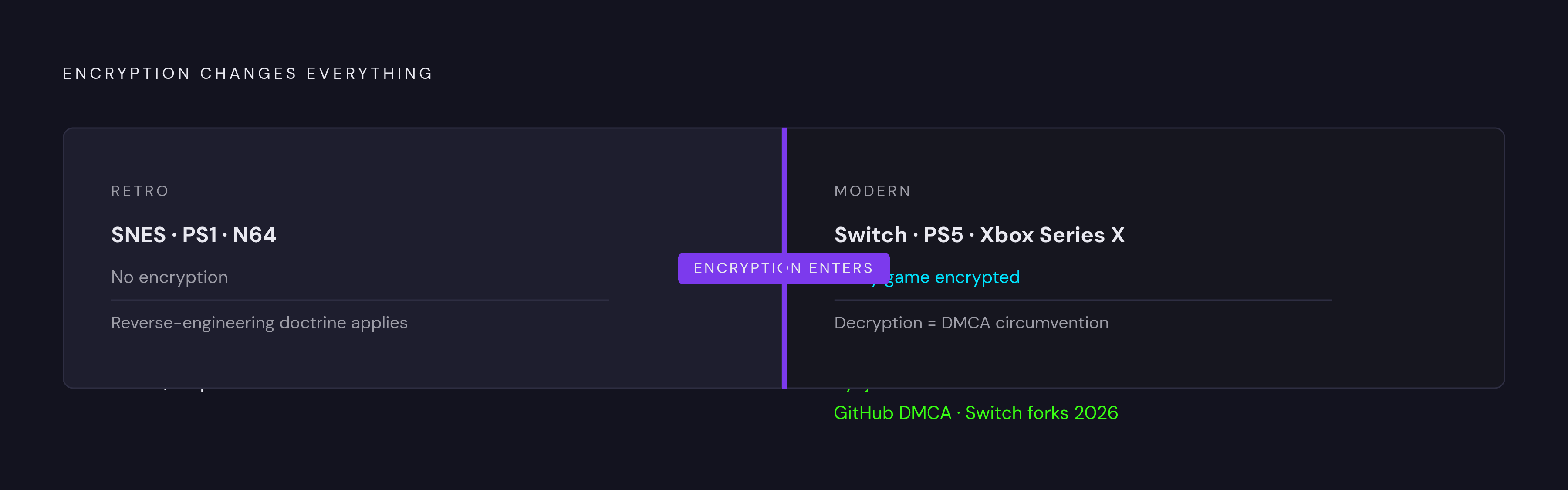
Retro hardware, the SNES, the PS1, the N64, had minimal or no encryption, which means the reverse-engineering doctrine that protects emulation applies cleanly to them. A retro console game is vulnerable to a clean-room approach. A Switch game is not. The Nintendo Switch, PS5, and Xbox Series X encrypt every game, and playing a Switch game on an emulator requires decrypting that content. That decryption is itself the circumvention act that anti-circumvention law targets, a standalone violation even if the player owns the game outright.
The enforcement history bears this out. Ryujinx shut down in October 2024 after Nintendo made contact with the developer, and in 2026 Nintendo escalated with DMCA takedowns against open-source Switch emulator forks on GitHub. BIOS files carry the same problem in a different form: distributing or downloading a console BIOS from the internet is unambiguously illegal because it is distributing copyrighted code, and this applies to the PS1, PS2, and Sega Saturn BIOS files that many emulators require. None of this should frighten a player away from retro emulation. It should instead make clear that retro and modern console emulation are legally different animals, and that a player can place their own use case on the spectrum simply by asking which generation their console belongs to.
Where enforcement actually lands — and what that means for an individual mobile player
The enforcement gap between what the law prohibits and what anyone prosecutes is worth naming precisely. No private individual has ever been criminally prosecuted for personal emulation use. When game publishers pursue infringement claims, they target ROM distribution sites and emulator developers, not players loading up old games on their lunch break. Nintendo successfully sued the operators of LoveROMs and LoveRETRO for millions of dollars, and the profile of the target is consistent: a site distributing thousands of ROMs at commercial scale, not a person with a phone and a controller.
Civil penalties under US copyright law are technically large, ranging from $750 to $150,000 per work depending on whether the infringement was willful. But lawsuits against individuals for downloading ROMs are nearly nonexistent in practice. The reason is straightforward. Suing a player produces no meaningful deterrent and no significant recovery, while suing a distribution site removes the supply at its source. Publishers rationally allocate enforcement to the node with the greatest leverage.
That does not mean "no one gets sued" is the takeaway. Competitive consequences operate independently of legal liability, and they reach players faster. Using an emulator in organized play is almost universally treated as cheating by tournament organizers, and the consequences include in-game bans, disqualification, forfeiture of prizes, and reputational damage. Supercell updated its Terms of Service to forbid emulator use, asserting its right to ban players for using them, and cited emulators among prohibited software. A player can be entirely free of legal exposure and still lose an account or a tournament result, because the ToS is a contract, not a statute, and it binds in ways the copyright system does not.
What the preservation argument reveals about where the law falls short
The strongest objection to the current legal framework does not come from players who want free games. It comes from historians. A large majority of pre-2010 games are no longer accessible through any commercial channel, 87% by one measure, and the cause is structural rather than commercial. Physical media degrades, original hardware becomes scarce, and storefronts close. Publishers did not choose to retire most of these titles. They simply became unreachable.
The Video Game History Foundation spent three years supporting the Software Preservation Network on a petition that would allow libraries and archives to remotely share digital access to out-of-print games with researchers. The Copyright Office rejected the exemption, siding with the Entertainment Software Association, which declared that it would never support remote game access for research purposes under any conditions. Under current anti-circumvention rules, libraries and archives cannot legally break copy protection on games in their collections to make them remotely accessible, even for scholarship. The VGHF's response was pointed: the industry's resistance "forces researchers to explore extra-legal methods to access the vast majority of out-of-print video games."
That is the most powerful objection to treating ROM downloading as straightforwardly equivalent to piracy. The player downloading an out-of-print game with no legal alternative is in a different moral position than one copying a game currently for sale, even if the law treats them identically. This objection does not change what the law says. It explains why the law feels unsatisfying to many players, and why the preservation debate continues even after the legal analysis has reached something close to a consensus.
The clearly legal paths for sourcing ROMs and retro game content on mobile
Several routes for building a playable retro library on a mobile device are either unambiguously legal or carry the lowest demonstrable risk, and they cover a wider range of games than most players expect. The easiest category to state plainly is the one with no attachment to copyright at all. Games whose copyrights have expired or been forfeited, freeware titles, homebrew releases, and official demos released by publishers are unambiguously legal to download and run. Atari 2600-era games are beginning to approach the public domain threshold under US law. NES-era and later games are not close, and a player should not mistake proximity for arrival.
Self-dumping from cartridges and discs you own sits in the more complicated position. Using hardware such as the Retrode 2 or a Kazzo USB dumper to copy a cartridge you own sits in a legal gray area under Section 117, but it is the lowest-risk personal path, and no company has ever successfully sued an individual for dumping their own games and playing them locally. For BIOS-dependent emulators on the PS1, PS2, and Sega Saturn, extracting the BIOS from a console you own using homebrew software places you in the same gray zone as self-dumping, still lower risk than downloading from a third-party site. For Switch owners, dumping game content using NxDumptool from a console you own avoids downloading games from the internet, though prod.keys must first be generated separately using Lockpick_RCM on the console, which is where the infringement risk lies. It is worth being precise about what "gray area" means: the legal footing is debated and unresolved by appellate courts, not secretly legal. Commercial channels have closed much of the remaining gap. Antstream Arcade streams retro games without requiring ROM downloads at all, a streaming approach that sidesteps the file-ownership question entirely and reduces the legal exposure to the same terms that apply to any subscription service.
How the iOS App Store opening and Delta's launch changed what mobile emulation looks like in practice
The April 2024 revision to Apple's App Store Guidelines §4.7 marked a genuine threshold for iPhone players. Apple had never explicitly permitted emulators before that date, and the rule change, which is worldwide, added games from retro game console emulator apps to the list of permitted software. Delta launched on the App Store on April 17, 2024, though it was excluded from the EU at launch, and accumulated millions of downloads in the months that followed. PPSSPP arrived about six weeks later on May 15, 2024, initially limited to US users. The speed and scale of adoption suggest how large the latent demand was, millions of iPhone owners waiting years for a store-approved path to the software Android users had enjoyed through the Play Store and sideloading for far longer.
EU users face a different path because of the Digital Markets Act. They install AltStore PAL first, then download Delta through AltStore's Browse tab, and unlike direct App Store installs, AltStore versions must be refreshed periodically. The extra step is a reminder that the same legal software can arrive through different regulatory doors depending on geography.
The crucial point for anyone following the argument through to its end is that a store-approved emulator does not change the legal status of ROM sourcing. Delta on the App Store runs game files the user provides, and those files must still be obtained through a legal route. What changed in April 2024 was the legality and availability of the emulator half of the equation, which was already settled law and is now settled policy. The other half remains exactly where this article has placed it.
The emulators that thrive in this new environment, Dolphin, PPSSPP, DuckStation, RetroArch, and ScummVM, are those built on clean reverse engineering without circumvention tooling bundled in. That is not a coincidence. The App Store opening selected for the same architecture the courts had already blessed, and mobile emulation as it now exists is the clean end of the spectrum made visible. A legal emulator, a legally sourced library, and a controller already make the phone in your pocket into what it has quietly been for years: a real gaming setup.