Best Gaming Phone Specs to Target in 2026
Sustained performance and thermal management matter more than peak specs when gaming.

Run a benchmark for 60 seconds on a cold chip and you'll learn almost nothing about how that phone plays 45 minutes into a ranked match. Specs split into two piles: the ones that shape every session you'll ever play (chipset, cooling, refresh rate) and the ones that mostly matter when you're comparing charts to decide if you need the extra feature at all.
Almost every flagship chip scores well right out of the box, because that's just what chips do when they're cold and nobody's asked anything hard of them yet. What separates a real gaming phone from a flagship that happens to run games fine is whether the frame rate at minute 30 looks anything like the frame rate at minute one. That gap is what actually matters.
Manufacturers print the peak number because it looks good on a spec sheet next to a lightning bolt icon. This piece cares about the floor instead: the number you can count on holding for an hour, which is the number nobody prints but everybody feels by the second half of a match.
Five things carry the weight below: chipset and how it holds under load, display, RAM and storage, battery, and thermal management. Connectivity gets its own section too, further down, since 5G and Wi-Fi 7 matter in a quieter way than thermals do.
Chipset: what the Snapdragon 8 Elite generation actually means for sustained gaming
Snapdragon 8 Elite Gen 5 runs the show across nearly every serious Android gaming phone this year. The RedMagic 11 Pro runs it. So does the Galaxy S26 Ultra, the OnePlus 15, and the Nubia Z80 Ultra. Shop Android flagships in 2026 and you'll bump into this exact chip over and over, which makes it genuinely hard to tell phones apart by chipset name alone.
On the Apple side, the A19 Pro, built on a 3nm process and found in the iPhone 17 Pro Max, sits in a comparable weight class. Different architecture, different ecosystem, roughly the same punch if raw capability is all you're grading.
Here's the part that trips people up: two phones running the identical chip can behave very differently once that chip starts to sweat. Android Authority's testing found the RedMagic 11 Pro was the only phone able to run Qualcomm's newest chipset at full capacity without backing off. The Galaxy S26 Ultra, meanwhile, runs a "for Galaxy" variant of the Elite Gen 5, tuned by Samsung's own calibration rather than the stock configuration. Same silicon family, different tuning, different results, and that's before thermal design even shows up.
Chip tier alone doesn't tell the story. Thermal management, covered in its own section below, decides whether that chip actually delivers its rated performance across a full match instead of just the first five minutes. RedMagic also builds in the RedCore R4, a dedicated co-processor that handles gaming-specific logic on top of the main chip, a layer standard flagships skip entirely.
One more wrinkle worth flagging: if you lean on cloud gaming or remote play, raw compute stops being the whole picture. Decoding a high-resolution video stream from a server is a different job than running a game engine on the phone itself, so check that a phone handles both well instead of assuming one guarantees the other.
Display refresh rate: where the real threshold is and where spending more stops mattering
Refresh rate is the spec everyone argues about, and it's also the one where returns fall off fastest once you cross a certain line. Going from 60Hz to 90Hz is a real, felt difference; you notice it the first time you swipe a home screen. 90Hz to 120Hz helps in anything fast-twitch, but past that, at 144Hz and up, you're paying for headroom fewer and fewer games actually push.
The ASUS ROG Phone 9 Pro currently owns the ceiling with a 185Hz display, the fastest on any Android phone in 2026. Most games don't run anywhere near 185 frames per second though, and most players, thumbs actually on the glass, won't tell 165Hz from 185Hz in a blind test. It's the kind of spec that reads better on paper than it feels in your hand.
Casual games and RPGs are covered fine at 90 to 120Hz. Competitive shooters or fighting games, where a single frame genuinely swings a match, want 120Hz minimum with 144Hz as the sweet spot. Past that, 144 to 165Hz is enthusiast territory, which is where the OnePlus 15 (165Hz) and RedMagic 11 Pro (144Hz) both sit.
Every top-tier gaming phone in this field uses AMOLED, so panel type stopped being a real differentiator a while back. What varies is LTPO, which adjusts refresh rate to match what's on screen and saves battery doing it; both the iPhone 17 Pro Max and OnePlus 15 do this. Display size clusters between 6.78 and 6.9 inches across the field, big enough to feel immersive without wearing out your hand over a long session.
One spec gets lumped in with display but has nothing to do with the screen itself: touch sampling rate, like the 520Hz shoulder triggers on the RedMagic 11 Pro. That measures how fast the phone registers your input, and it matters most when you're gripping the phone bare-handed. Clip a physical controller like Backbone onto the phone and touch latency mostly drops out of the equation, since your thumbs land on buttons instead of glass. At that point, display quality and size matter more than chasing the highest refresh number on the shelf.
RAM and storage: the minimums that prevent session-breaking stutters
8GB of RAM is the floor for 2026. Go below that and you'll notice the phone quietly killing background apps to make room, which is exactly the kind of thing that ruins a session: you tab out to check one Discord message and come back to a game that reloaded from scratch, boss fight and all, gone.
At the top end, the ASUS ROG Phone 9 Pro and RedMagic 11 Pro offer up to 24GB, which sounds like overkill until you walk through what it actually buys you: recording gameplay, running a second app, and keeping the game fully loaded, all at once, with none of them shoving the others out of memory. The RedMagic 11 Pro pairs up to 24GB of LPDDR5T RAM with up to 1TB of UFS 4.1 Pro storage, and that storage spec isn't just about how many games fit; UFS 4.1's faster read speeds cut load times for open-world titles carrying heavy local assets.
8 to 12GB covers most people running one game at a time, no drama involved. 16GB and up starts to matter if you stream, multitask heavily, or run cloud gaming while capturing footage locally. 24GB is the ceiling, and it mostly matters if you're already buying a dedicated gaming phone with active cooling to match, since that much RAM tends to travel with hardware built for sustained heavy use anyway.
UFS 4.1 outpaces the older UFS 3.x standard in read speed, which shows up as shorter waits between zones in AAA-tier mobile titles. And while 1TB is more than most people will ever fill, 256GB gets tight fast once you've got two or three large modern games installed at once.
Battery capacity and charging speed: what actually gets you through a long session
Gaming drains a phone battery faster than almost anything else you do with it. It hammers the GPU, the display, and the modem all at once, in a way scrolling social media never comes close to touching. Target 5,000mAh as the floor for regular play, and 6,000 to 7,500mAh if your sessions run long.
Here's where the field actually lands. The RedMagic 11 Pro leads at 7,500mAh, the largest in its class, and the OnePlus 15 comes in around 7,300mAh using a silicon-carbon battery, paired with 80 to 100W fast charging. The Galaxy S26 Ultra sits lower on paper at 5,000mAh, but Tom's Guide testing found it charges to 77% in 30 minutes and lasted nearly two hours longer than its predecessor, which tells you efficiency counts for as much as raw capacity does. The iPhone 17 Pro Max sits around 4,500 to 5,000mAh equivalent, offset by how efficiently the A19 Pro spends that power.
One spec worth knowing: bypass charging, which routes wall power directly to the phone's active systems while you play, skipping the battery entirely. That keeps heat down and spares the battery long-term wear during a plugged-in session. It shows up on the OnePlus 15, and it's missing from most standard flagships. The OnePlus 15's silicon-carbon chemistry deserves its own mention too; it packs more energy into the same physical size and handles heat better than standard lithium-ion.
Charging speed means something different here than it does for everyday phone use, since you're rarely topping up between meetings with a gaming phone. Either you're playing long enough that raw capacity has to carry you unplugged, or you're plugged in and need bypass charging so the phone isn't generating excess heat on top of whatever the game already produces.
Thermal management: the spec that determines whether your phone actually performs or just claims to
Here's the part spec sheets never print: even the best chipset on the market throttles if the phone can't shed heat fast enough, and that throttling usually kicks in somewhere between 20 and 30 minutes into a demanding game. Whatever gap you feel between what the box promised and what you're actually getting an hour into a match, that's thermal throttling doing its quiet, unadvertised work.
So what do you actually check for? Vapor chamber cooling is passive and shows up in plenty of flagships, while active fan cooling is rarer and mostly lives in phones built specifically for gaming. The RedMagic 11S Pro stacks several layers together: a large vapor chamber, liquid metal, flowing liquid cooling, and a built-in fan spinning at 24,000 RPM. That's a design built around active heat management, not a hopeful sticker on the box. The Galaxy S26 Ultra, by comparison, relies on passive cooling, and testing notes describe gradual throttling setting in during longer sessions.
There's a simple test that cuts through all of this: check how the phone performs at minute 30 of a demanding game, not minute one. No spec sheet answers that question, because nobody prints "still fine after half an hour" on a box.
The trade-off is real. Active cooling adds bulk and weight, because a fan and liquid loop have to live somewhere inside the chassis. A lighter, pocketable flagship comes with a passive ceiling, while a heavier dedicated gaming phone holds its performance longer. What you're optimizing for decides which one wins, and neither answer is wrong; it depends what you're actually doing with the thing.
Cloud gaming eases this problem some, since the heavy GPU lifting happens on a server instead of in your hand. You're still leaning on the phone's CPU and display to decode smoothly and keep input lag low, so thermal performance still counts, just less than it does with a locally rendered game. And pairing a well-cooled phone with a physical controller solves a problem you might not have named yet: your hands aren't gripping a warm screen anymore, they're on buttons, which quietly stretches how long a session stays comfortable.
Connectivity specs that affect actual play: 5G and Wi-Fi 7
Wi-Fi 7 is table stakes on top gaming phones in 2026, the RedMagic 11 Pro included. At this tier, having it isn't a selling point; it's just the baseline you'd expect from a phone at this price.
5G is the more interesting variable now. Global 5G subscriptions passed 1.9 billion in 2025, and in well-covered areas, latency under 20 milliseconds is genuinely achievable, fast enough to make mobile multiplayer and cloud gaming feel responsive away from home Wi-Fi. There's also gaming-grade network slicing worth watching, where carriers in South Korea and China started offering premium subscribers dedicated low-latency lanes as of 2025. Not universal yet, but it points at where mobile networks are heading.
Gaming at home on Wi-Fi, Wi-Fi 7 support is the only box to check. Gaming on the go with cloud services, your carrier's actual 5G coverage where you live and commute matters far more than the theoretical ceiling printed on a spec sheet. And if you're pairing a wireless controller, check that the phone supports a current Bluetooth standard; that's what keeps the pairing stable and input lag low enough that button presses register without a noticeable delay.
How the top 2026 gaming phones actually stack up against these thresholds
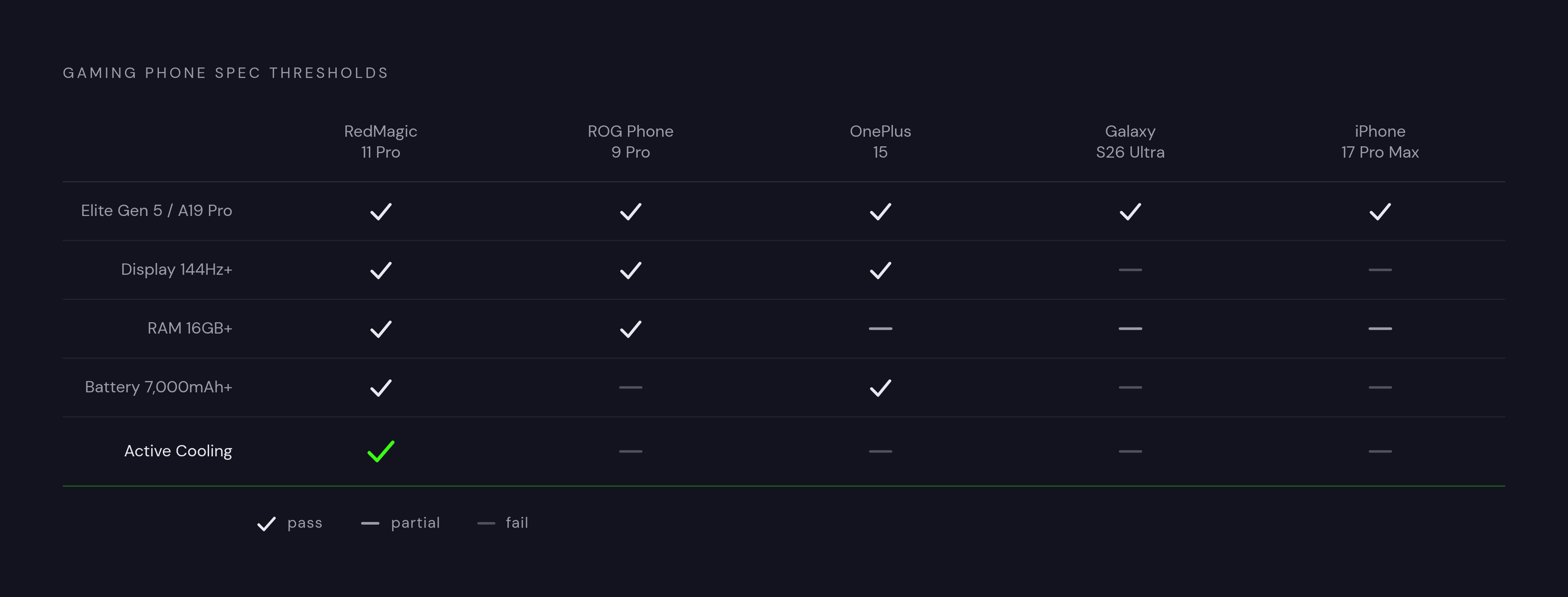
The ASUS ROG Phone 9 Pro remains the incumbent everyone measures against, with its 185Hz display and up to 24GB of RAM still holding up on paper. But ASUS confirmed there's no 2026 successor coming, so as the year rolls on, the 9 Pro ages in place while newer releases pass it by.
The RedMagic 11 Pro is, by the thresholds above, the clearest dedicated gaming phone of the year: Snapdragon 8 Elite Gen 5, a 144Hz AMOLED display, a 7,500mAh battery, 24GB of LPDDR5T RAM, 1TB of UFS 4.1 Pro storage, and active multi-layer cooling, all starting at a competitive price point. It checks every box this piece has walked through. The RedMagic 11S Pro is coming behind it with an overclocked version of the same chip, which raises a question worth sitting with once it launches: overclocking generates more heat, so does the cooling stack actually scale up to match, or does that extra clock speed live mostly on paper?
The OnePlus 15 offers a 165Hz display, roughly 7,300mAh of silicon-carbon battery, and bypass charging, making it a strong pick for someone who wants endurance without buying into the full gaming-phone form factor, fan and all. The Galaxy S26 Ultra runs 120Hz, 5,000mAh, and genuinely fast charging (77% in 30 minutes) on the same Elite Gen 5 chip tuned for Galaxy; it's the right call if you want one premium phone that games well without being built around gaming exclusively, and you're fine accepting passive cooling as the cost of that flexibility. The iPhone 17 Pro Max, running the A19 Pro, stays the pick for anyone committed to iOS and Apple Arcade, its smaller battery offset by how efficiently that chip runs.
Lined up against the thresholds: chipset tier is basically a non-issue, since every phone here sits in Elite Gen 5 or A19 Pro class. Display clears 120Hz across the board, with 144Hz-plus reserved for the dedicated gaming phones and the OnePlus 15. RAM clears the 8GB floor everywhere, and the 24GB ceiling belongs only to the ROG 9 Pro and RedMagic 11 Pro. Battery clears 5,000mAh everywhere, with 7,000mAh-plus limited to RedMagic and OnePlus. Thermal management is where the field actually splits: active cooling belongs to RedMagic alone, and everyone else works with vapor chamber or fully passive systems.
What a physical controller adds on top of any phone you choose
Touchscreen controls carry a built-in compromise no phone here escapes, no matter how good its chipset or how many layers of liquid cooling it's packing. You're tapping glass to simulate a button, and your thumbs cover part of the screen while you do it. A physical controller sidesteps that entirely, working alongside whatever specs the phone brings to the table.
Clip on a physical controller and a few things happen at once. Your thumbs move to actual buttons and sticks, so you get tactile feedback and a full view of the screen instead of half of it disappearing under your hands. Heat stops being a hand problem too, since your palms aren't pressed against the warmest part of the device anymore; that makes a phone's thermal ceiling matter less to your comfort, even though it still matters to frame rate. The touch sampling rate mentioned earlier, that 520Hz spec, becomes mostly beside the point, since you're not touching the screen to play in the first place.
The specs in this piece decide how well a phone runs a game. A controller decides how well you play it, which is a separate question that no chipset benchmark will ever answer for you. For most serious mobile gamers in 2026, the honest answer is you want both: a phone that clears the thresholds above, and a controller that gets your hands off the glass.