Best Gaming Phones for Mobile Gamers in 2025
Your best gaming phone depends entirely on how you actually play.

Mobile gaming stopped being a niche hobby somewhere around the time your uncle started grinding battle passes on his lunch break. Searches for "best gaming phone 2025" jumped 66% in early 2026 according to Google Trends, and that spike tracks with new chipsets landing, AAA console ports showing up on phones that used to only run "Candy Crush," and a player base that now skews well past college age. This piece walks through what actually determines gaming phone performance in 2025, and argues that the "best" phone depends less on raw power and more on how you play, for how long, and with what controller in your hands.
The 2025 gaming phone market has contracted sharply on the dedicated side: ASUS announced it will stop releasing new smartphones starting in 2026, leaving RedMagic as effectively the only company still building phones from the ground up for gaming. Apple and Samsung continue closing the performance gap with mainstream flagships, so the field is now split between one true gaming specialist and several powerful all-purpose devices. Which of those options is actually best depends entirely on how you play, casual puzzle and narrative titles on short sessions favor a mid-range chip with a comfortable screen and large battery, competitive multiplayer and shooters reward high refresh rate, active cooling, and programmable shoulder controls, and cloud streaming sessions (Xbox Cloud Gaming, GeForce NOW, PS Remote Play) care far less about processor muscle than display quality, Wi-Fi antenna performance, and battery endurance. A rough rule of thumb: if you regularly cross the 45-minute mark on something graphically demanding, the RedMagic 11 Pro's active liquid cooling and 7,500mAh battery start to matter in ways a mainstream flagship's vapor chamber simply cannot match.
The stakes are bigger than they look from the outside. Worldwide player spending across the App Store and Google Play hit $76.7 billion in 2025, and eight of the top ten titles each cleared $1 billion on their own. That's an industry with real hardware demands behind it. And the hardware landscape just got a lot smaller on one side: ASUS announced it will stop releasing new smartphones starting in 2026, which leaves RedMagic as effectively the only company still making phones built from the ground up for gaming. Meanwhile Apple and Samsung keep closing the performance gap with their mainstream flagships. So the obvious pick isn't obvious anymore. It depends on you.
The four things that actually determine gaming phone performance
Forget the benchmark chart for a second. What actually separates a great gaming phone from a mediocre one in 2025 comes down to four things: the chip, the screen, the cooling, and the battery, and specifically how those four things behave after twenty minutes of sustained load, not in the first thirty seconds of a synthetic test.
Start with the processor. Snapdragon 8 Elite, and now its Gen 5 update, dominates the top tier of Android gaming phones this year. On the Apple side, the A19 Pro pushes rendering close enough to console quality that full ports which used to need a PC or a PlayStation now run on a phone in your pocket. But here's the thing nobody puts on the spec sheet: peak speed is basically a party trick if the chip can't hold that speed. A processor that hits its top clock for ninety seconds and then throttles down to save itself from melting is giving you a really good demo, not console-tier performance.
Display specs have gotten genuinely wild. Mainstream flagships sit around 120Hz refresh, while dedicated gaming phones push as high as 185Hz. Peak brightness has climbed to a range of 1,800 to 2,000 nits among the top devices, which matters more than people think if you've ever tried to play outside in July and stared at your own reflection instead of the game. Resolution and AMOLED panel quality affect visual fidelity too, but they also affect power draw, which loops right back into the battery conversation.
Cooling is the part most buyers underestimate, and I get why. Almost any current flagship can run 95% of what's on the Play Store without a hiccup. The separation shows up over time and under heat. Vapor chamber cooling, which most mainstream flagships use, is solid; active liquid cooling, like the AquaCore system in the RedMagic 11 Pro that circulates coolant with an internal pump, is a different category of solution. Independent thermal testing found the 11 Pro's surface temperature stayed at or below 42°C during 30-minute sessions of "Genshin Impact," meaningfully cooler than mainstream flagships running without active cooling. That's the difference between a phone that stays snappy and one that quietly throttles itself into a nap.
Battery size ties directly to how long your sessions run. If you're regularly gaming past the 45-minute mark on something graphically demanding, battery capacity and thermal management stop being separate specs and start being one combined problem. The range across the field is wide: 7,500mAh in the RedMagic 11 Pro, 5,800mAh in the ROG Phone 9 Pro, 6,000mAh in the RedMagic 10 Air. Charging speed and other charging features vary across devices, and dedicated gaming phones don't always win there.
One honest caveat: RGB lighting, shoulder triggers, and dedicated game-mode toggles are real and some of them are genuinely fun. But they're secondary to the core experience. The four pillars above are where a session actually gets won or lost.
How to match a phone to the way you actually play
Here's a question worth sitting with before you spend hundreds of dollars or more: what do you actually play, and for how long? Not what you think you might play someday. What's currently on your home screen.
If it's puzzle games, idle games, or narrative stuff you dip into for ten minutes at a time, a mid-range chip handles that without breaking a sweat, and a dedicated gaming phone is total overkill for that use case. Prioritize screen comfort and battery size and call it a day.
If you're in competitive multiplayer, shooters like "Call of Duty Mobile," or arena titles where a quarter-second of input lag is the difference between a kill and a respawn screen, the calculus changes. High refresh rate, a strong chip, and active cooling all start to matter, and shoulder buttons or programmable controls stop being a novelty and become a genuine edge.
Then there's cloud streaming and remote play, covering things like Xbox Cloud Gaming, PS Remote Play, GeForce NOW, and Steam Link. Here the processor barely matters, since the heavy lifting happens on a server somewhere far away. What matters instead is display quality, Wi-Fi antenna performance, and battery endurance for the long haul, because these sessions tend to stretch.
The honest truth is that any modern mid-range Android phone or iPhone runs casual titles effortlessly. The case for a gaming-specific device only gets compelling once you're competitive or cloud-streaming for real stretches of time. Use 45 minutes as your rule of thumb. Cross that regularly on something graphically intense, and you'll start to feel exactly what cooling and battery are for.
This also sets up a point that keeps resurfacing later: whichever phone you land on, pairing it with a physical controller changes what that phone is capable of. Phone choice and controller choice aren't separate decisions. They're the same decision made in two parts.
With ASUS gone, what do the remaining dedicated gaming phones actually offer?
With ASUS stepping away from phones in 2026, RedMagic is now the only company building dedicated gaming phones at scale, which makes this section shorter than it would've been two years ago, but no less useful.
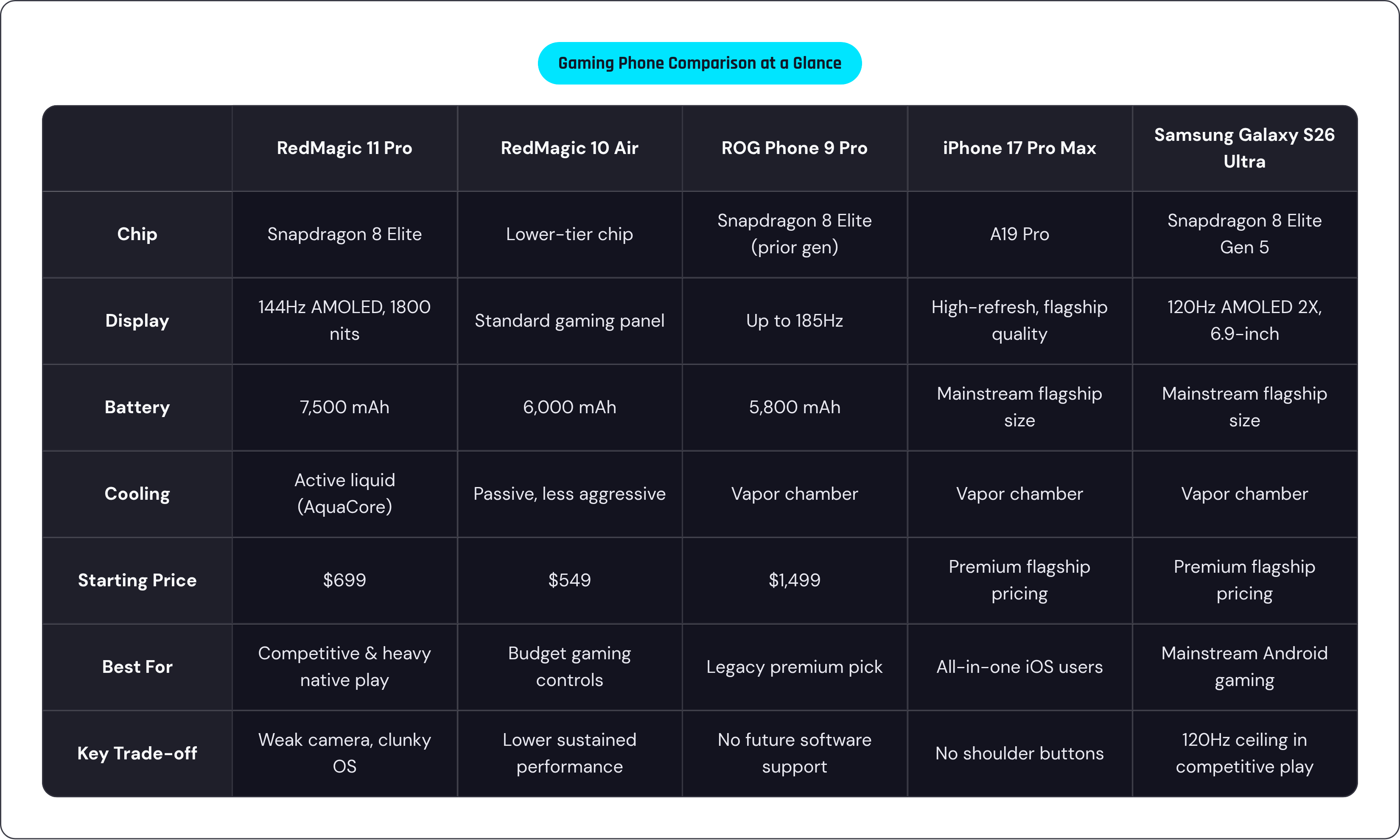
The RedMagic 11 Pro is the strongest overall pick in this category. It runs Snapdragon 8 Elite, a newer chip than the one in the outgoing ROG Phone 9 Pro. RAM ranges from 12GB up to 24GB depending on the storage tier you pick, starting at $699 for 12GB and 256GB, stepping up to $799 for 16GB and 512GB. The display is a 144Hz AMOLED panel at 1216 by 2688 resolution with peak brightness of 1,800 nits. Battery capacity sits at 7,500mAh, a substantial pack for a phone in this category. Cooling comes from that AquaCore active liquid system, which as far as anyone can tell is the first mass-produced phone to circulate actual liquid coolant internally rather than just spreading heat across a vapor chamber, and the 42°C sustained thermal results back up the marketing rather than contradicting it. Physical shoulder buttons and a dedicated game-mode slider round out the hardware.
Now the trade-offs, stated plainly: the under-display selfie camera is not good, and RedMagicOS 11, the software skin layered over Android, feels a little clunky in places. This is not the phone to carry if photography or a polished software experience matters to you. It's the phone for competitive multiplayer players and heavy native-title gamers who want sustained performance more than they want a great camera.
The RedMagic 10 Air is the budget option, starting at $549 (£439) for 12GB of RAM and 128GB of storage. It carries a 6,000mAh battery, which is strong endurance for the price, and it keeps the physical shoulder buttons, which do real work in shooters like "Call of Duty Mobile" and action RPGs like "Genshin Impact." The performance ceiling sits lower than the 11 Pro, since cooling isn't as aggressive, and you'll notice that gap specifically during long, heavy sessions. But for players who want gaming-specific controls and solid battery life without paying flagship money, it covers most of the bases.
Worth a quick note on the ROG Phone 9 Pro, since it's still floating around as a comparison point: a display rated at up to 185Hz, $1,499 (£1,299.99), 5,800mAh battery, a 50MP Sony Lytia camera. It was a genuinely premium device. But with ASUS exiting the smartphone market in 2026, buying one now means buying into a phone with no future software or hardware support behind it, which is a rough position for anyone who cares about staying current.
When a mainstream flagship is the smarter gaming phone
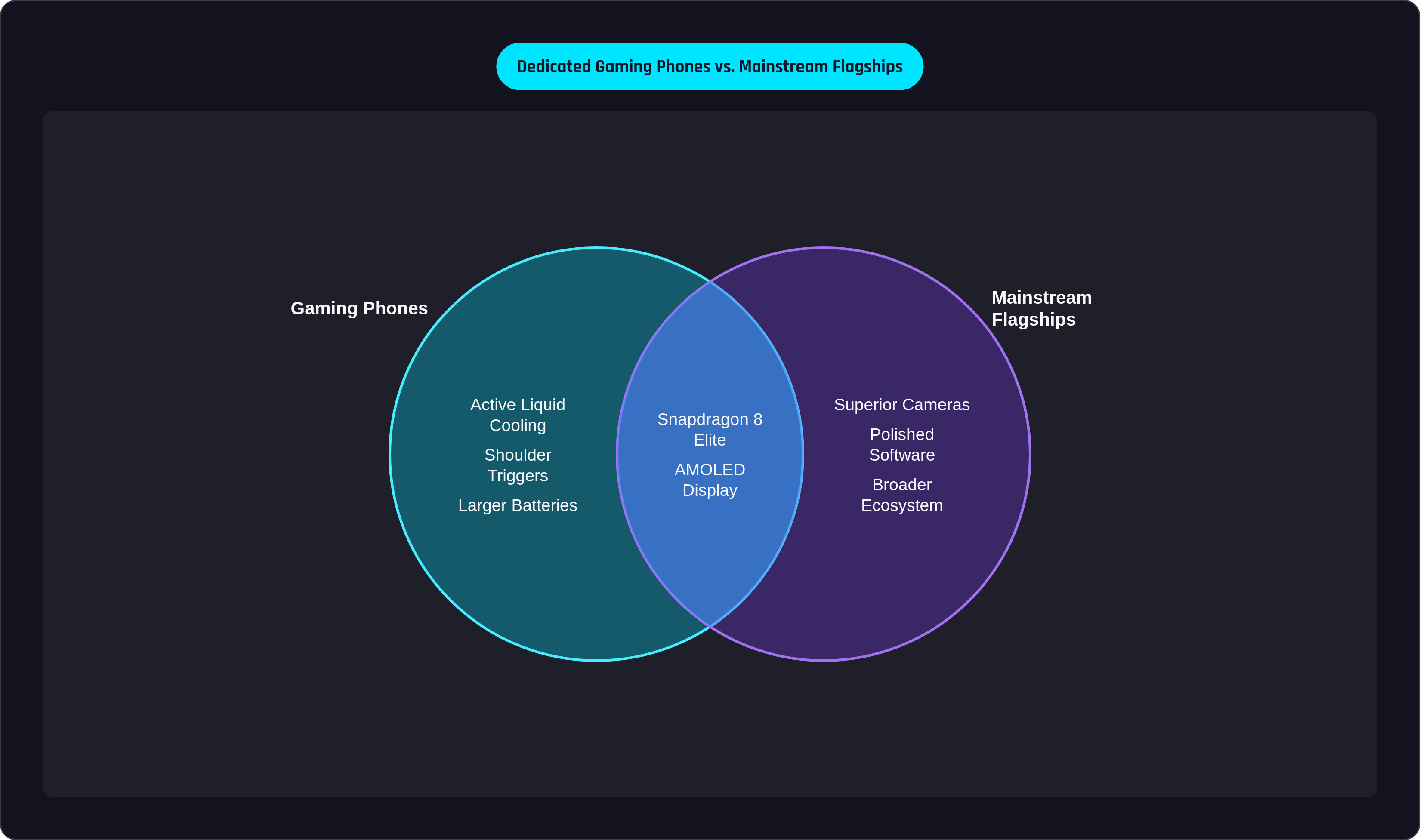
Here's the baseline nobody likes to admit until they've actually tested it: nearly any Android flagship runs 95% of what's on the Play Store, and the remaining 5% is where specialized gaming phone hardware earns its place. Dedicated gaming phones win on consistency and features layered on top rather than on access to games. That's a meaningfully different argument, and it changes who actually needs one.
The iPhone 17 Pro Max is, per TechRadar, the best iPhone for gaming right now, pairing the A19 Pro chip with a smooth high-refresh display and a strong camera system. That A19 Pro chip is what unlocks console-grade ports that were previously stuck on dedicated hardware. The pitch here is that you get one device that handles gaming, photography, and everything else without the compromises that come baked into a gaming-first phone. The broader iOS game catalog adds to the case. For cloud gaming specifically, whether that's Xbox Cloud, GeForce NOW, or PS Remote Play, the display and chip here are more than enough; your bottleneck becomes your Wi-Fi and your controller, not the phone in your hand.
The Samsung Galaxy S26 Ultra runs Snapdragon 8 Elite Gen 5 for Galaxy alongside a 6.9-inch AMOLED 2X display at 120Hz, which is a genuinely capable gaming setup in a flagship body. The ceiling of 120Hz versus 144 to 185Hz on dedicated gaming phones is a real, feelable difference in competitive play; it's a lot less noticeable once you're cloud streaming or playing something casual.
The Samsung Galaxy Z Fold 7 makes a different argument entirely: unfold it and you basically have a mini tablet, and RPGs, strategy games, and cloud sessions all feel more cinematic on that extra real estate. The trade-off is a thicker, heavier device that isn't great for long handheld sessions with a controller clipped on.
The through-line across all three: for cloud gaming and remote play, mainstream flagships close most of the distance to dedicated gaming phones. At that point, the controller and the network you're on start mattering more than which phone happens to be in your hand.
How cloud gaming changes the phone-selection calculus
Cloud gaming flips the usual priority order upside down. When the actual game processing happens on a server somewhere and your phone is just displaying the result, the chip inside your phone becomes almost beside the point. Display quality, network antenna strength, and battery life move to the front of the line instead.
Three platforms dominate here, and they work in meaningfully different ways. GeForce NOW streams games you already own on Steam, Epic, Ubisoft Connect, or Battle.net; it streams games you already own at varying quality tiers depending on your connection and subscription level. A strong, stable connection is essential, so don't expect miracles on hotel Wi-Fi. Xbox Cloud Gaming works on a different model, giving you access to a library of titles with stream quality adjusting to your connection; it has continued to expand its reach across devices. PS Remote Play and Steam Link take a different approach, letting you stream from your own hardware, where network stability and latency are really the whole game.
What does this mean practically? A mid-range phone with a great screen and strong wireless antenna performance can genuinely outperform a gaming-specific phone with a weaker antenna during a cloud session. The spec sheet doesn't tell the whole story on its own.
Battery still isn't optional, though. Cloud streaming is a nonstop data-and-display workload, full stop, no breaks. That 5,800mAh battery in the ROG Phone 9 Pro versus the 7,500mAh pack in the RedMagic 11 Pro translates into a real difference in how long you can play before hunting for an outlet.
Why the controller you pair with any of these phones matters as much as the phone itself
Here's an argument I'll make bluntly: touch controls put a ceiling on precision and comfort that no chip, screen, or cooling system can lift. That's true in competitive shooters, action RPGs, and honestly any cloud-streamed console game where you're trying to replicate a controller experience with your thumb smearing across glass.
Attach a real controller, though, and the whole category shifts. A phone with a controller clipped on becomes a handheld console, with the phone's display, chip, and battery serving as supporting cast rather than the whole show.
What should you look for in a controller? The same things that matter in the phone itself, translated into a different form. Latency is the big one; a wired USB-C connection removes the variability that wireless introduces, which matters a lot in competitive play. Ergonomics matter too, since a controller built for long sessions needs to feel good in the hand after forty-five minutes, not just in the first five. Compatibility across the platforms you actually use, whether that's Xbox Cloud Gaming, PS Remote Play, GeForce NOW, Apple Arcade, or native Android titles, determines whether the thing sits in a drawer or lives in your bag. And form factor counts: a clip-style controller that attaches directly to the phone keeps the whole setup pocketable, one object instead of two.
Some clip-style controller lineups are built around exactly this use case, offering low-latency wired and wireless connections, an ergonomic design shaped by many thousands of part iterations and over 50 research studies, and broad compatibility across the phones covered in this piece, from the iPhone 17 Pro Max to the Galaxy S26 Ultra to the RedMagic 11 Pro. The practical upshot is straightforward: a $699 gaming phone with a good controller attached will beat a $1,499 phone running touch controls, in any game where physical input actually matters. The controller carries as much weight in the setup as the phone does.
Picking the right phone for how you actually play in 2025
Resist the urge to want one clean answer here, because there isn't one, and honestly there shouldn't be. What you actually need depends on three things you now have the tools to answer for yourself: what you play, how long you play it, and whether a controller is coming along for the ride.
If you're deep into competitive multiplayer or long native-title sessions, the RedMagic 11 Pro is the strongest pick, and pairing it with a physical controller is where it really separates from the pack. If budget is the real constraint, the RedMagic 10 Air gets you shoulder buttons and a 6,000mAh battery at $549, which covers most of what actually matters without the flagship price tag. And if you're an iPhone user who wants one device to handle gaming, photos, and everything else without carrying a second phone just for "Genshin Impact," the 17 Pro Max does that without asking you to compromise much of anything.
None of these are wrong answers. They're just answers to different questions, and the whole point of walking through the chip, the screen, the cooling, the battery, the play style, and the controller was to help you figure out which question you're actually asking.