Best Mobile Shooters and Action Games for Controller Play
Controller support transforms these competitive shooters from comfortable to genuinely competitive.
What Makes a Game Truly Reward a Controller Versus Merely Tolerate It
Three questions do most of the sorting here. Does a physical stick actually make you faster or more precise than a thumb dragging across glass? Does the game ask for inputs happening at the same instant, the kind where touch controls fail because one thumb is blocking the other? And does the studio keep maintaining controller support as a real feature, rather than a checkbox somebody flipped once and never touched again?
Games that demand movement, aim, a dodge, and an ability activation inside the same two seconds are where a gamepad earns its keep. Tap-and-wait mobile games, the kind where you poke a button every four seconds and then watch a cutscene, gain almost nothing from a controller. There's no fight worth winning there.
Official support is the tell, and it's the thing most players skip checking. Some titles list which pads they've tested, let you remap every button, and separate controller users from touch players in matchmaking. Call of Duty: Mobile does exactly that, according to Activision's own CoD Mobile Help Center: controller players get matched against other controller players so the aiming field stays level. That separation has a cost, though. The pool of controller users is smaller than the overall player base, so queue times can run longer while the matchmaker waits for a fair opponent.
Design lineage matters just as much as any patch note. Shadowgun War Games was built with a controller as the default input from day one. Plenty of other titles bolted controller support on after the fact because players complained loudly enough. The first category tends to feel tighter in the hand, because every menu and button prompt was laid out around a d-pad and triggers instead of retrofitted onto a touchscreen layout that was never built to hold a Bluetooth signal.
Hand fatigue over long sessions doesn't get talked about enough. Loot-grind games and open-world exploration titles eat hours at a stretch, and gripping a controller for three hours beats pinching a phone between two thumbs for that same stretch, every time. Comfort is a real feature, even though it does not appear on a spec sheet.
The best competitive shooters for controller play on mobile
Call of Duty: Mobile sits at the top, and not by a small margin. It's fast, it's competitive, and it runs both traditional multiplayer and battle royale. Controller-versus-controller matchmaking keeps things fair, and ADS sensitivity is tunable enough that recoil tracking with an analog stick genuinely beats swiping a thumb across glass. This is one of the clearest cases in the whole mobile catalog where the input itself changes outcomes, not just comfort.
Epic Games states that Fortnite is back on iOS worldwide except in Australia, and its controller layout maps close to one-to-one with the console version. Building and editing spread the workload across both sticks, both triggers, and the face buttons at once, which is exactly the kind of simultaneous-input demand touch screens choke on. Try building a ramp while aiming and firing with two thumbs on a 6-inch screen; it's a fight you'd otherwise win, made harder for no reason.
PUBG Mobile rewards a slower, more tactical pace. Fletchapp.com notes its maps run large, and positioning affects survival more than reflexes do, so analog movement fits the game's actual rhythm instead of fighting it. Looting, rotating between zones, holding a long sightline: all three lean on the kind of fine stick control a touchscreen simply can't offer.
Rainbow Six Mobile carries over the 5v5 tactical format, destructible walls, and operator gadgets from its PC and console sibling, and Plarium lists controller as the recommended input method here. Slow-angle clearing, where you inch a corner open a few degrees at a time, needs precision only an analog stick delivers.
Skich reports that Critical Ops keeps things stripped down: no pay-to-win economy, skill-based ranked modes, an active esports scene. Because it's nothing but gunplay with no other systems to lean on, it's one of the strongest arguments for analog aiming on a phone that currently exists.
Delta Force, inspired by Black Hawk Down, spans land, sea, and air combat across solo and co-op, Skich reports. Jumping between a helicopter gunner seat and ground combat usually means remapping your thumbs to new zones of the screen on touch. A controller skips that problem entirely, since the inputs stay fixed no matter what vehicle you're piloting.
And Shadowgun War Games deserves its own line as the clearest ground-up example in this category. fletchapp.com (2026) describes it as designed for controllers first, with full compatibility and customizable mapping built in from the start. Movement and aiming respond instantly, which is what happens when a studio builds the combat loop around a joystick instead of bolting one on after launch.
Tactical and looter shooters where the controller advantage is about feel, not just aim
Plarium states that The Division Resurgence transplants the third-person looter-shooter formula into a post-outbreak New York, complete with story missions, open exploration, and PvEvP dark zones. The camera work and cover system are where a controller earns its keep here: sweeping the analog stick around cover and pulling a trigger to aim down sights feels far closer to the console original than dragging a virtual thumbstick ever will. Anyone planning to sink real hours into gear grinding will notice the fatigue difference before the first loot cache even drops.
Modern Combat Versus, from Gameloft, runs a PvP hero-shooter format with more than 17 agents, cosmetic skins, and ranked seasons, Skich reports. Hero shooters stack ability timing on top of raw aim, and that structure maps cleanly onto shoulder buttons and triggers built for exactly that kind of split-second activation.
Pure PvP shooters don't carry the extra weight these games do: inventory screens, map traversal, economy management. A controller's d-pad and shoulder buttons handle a good chunk of that navigation cleanly, but plenty of menus in looter-shooters stay touch-only even with a controller plugged in. That's just how the genre works right now, not a sign of broken support, and it's common enough across these titles that a stick refusing to move a cursor shouldn't cause any alarm.
Action RPGs and hack-and-slash games where a controller changes how demanding content feels
AceGamer reports that Genshin Impact supports controllers fully on both iOS and Android, though the setting has to be switched on manually first, under Settings, then Controls. Combat throws a lot at the player at once: movement, aiming, dodging, swapping characters mid-fight, timing elemental reactions for damage bonuses. Each of those gets its own dedicated button on a controller instead of competing for the same patch of screen a thumb is already occupying. Given how the game is built around multi-hour exploration sessions, the reduced hand strain adds up fast, and some controllers even offer gyro aiming that helps bow users land headshots, AceGamer notes.
Diablo Immortal lists officially supported pads, and Udonis confirms the compatibility list and full button remapping. Dungeon runs live and die on ability cooldown management, positioning, and well-timed screen-clearing ultimates, and a controller carries that combat loop for hours without the physical toll a touchscreen session racks up. Endgame grinding is repetitive by design, so that lower physical cost isn't a nice-to-have; it lets a session finish instead of ending early because your thumb cramped.
Gamenguide reports that Hades brings its mythic hack-and-slash structure to mobile with the branching stories intact, and ability swaps mapped to the bumpers keep fights moving without breaking rhythm. Boon-switching and dash timing are the two mechanics doing the heavy lifting here, and both land on dedicated buttons instead of tap zones scattered across the screen.
T3 Arena bridges this section and the shooter section above it. Skich reports that it's a console-quality hero shooter with team and solo modes and a roster of distinct heroes, and its hero-ability architecture means managing cooldowns matters just as much as landing shots. That's the same logic driving Diablo Immortal and Hades, just wearing a shooter's clothing.
Roguelikes and action platformers where controller precision is the difference between a clean run and a dead one
Dead Cells punishes hesitation, full stop. It is a fast roguelite platformer with randomized level layouts and weapons that change every run, and death wipes progress while banking permanent upgrades. Touch controls technically work, but the game's whole identity rests on tight movement and clean combat, and any input delay gets punished immediately, not eventually. Dodge rolls and parries are frame-sensitive enough that analog input beats touch by a margin most other mobile games never force you to notice.
Alien: Isolation brings a console-quality horror experience to mobile, and heresthethingblog.com notes controller support specifically improves movement, stealth, and camera control, because the game demands careful movement and quick reactions. Stealth horror punishes overcorrection hard. Swipe a hair too far on a touchscreen and the thing stalking you finds you, while an analog stick gives the proportional, careful movement the tension actually calls for.
What connects these two titles is that failure happens instantly, and the cause traces straight back to input error. That's what makes the controller's precision measurable instead of just a vibe. Compare that to the looter-shooters above, where the controller's main gain is comfort over a long haul; here, the gain appears immediately, determining whether the run continues or ends on the spot.
Classic ports and arcade titles where controller support restores what the originals were designed for
Castlevania: Symphony of the Night stands as one of the strongest mobile ports available, and heresthethingblog.com notes controller support brings exploration, combat, and movement much closer to the original console feel. That's not surprising: the game was built for a d-pad and a handful of buttons two decades before touchscreens existed. Touch controls here were always a retrofit, and a controller just hands the game back the input language it was actually designed to speak.
Skich reports that Metal Slug 2 adds new characters, weapons, and vehicles on top of the arcade original, plus a mission mode and Bluetooth co-op. Run-and-gun arcade games were built for a joystick and a couple of buttons, and the whole feel of the game shifts the moment physical controls replace touch. The Bluetooth co-op mode is its own reason to care here: sharing a screen with a second player only stays comfortable when both people are holding a controller instead of elbowing each other for thumb space on the same glass.
Grand Theft Auto: San Andreas, remastered with its full mission list intact, snaps vehicle handling and shooting into place with a controller, Gamenguide notes. It was a console game first, and touch controls were always a workaround, never the intended way to drive a lowrider through that open world.
The MiniReview database lists 602 mobile games with controller support as of 2026, and classic ports make up a healthy share of that count. The case for all of them runs the same way: these games remember what a d-pad feels like, because that's what they were built around long before anyone thought to put them on a phone.
Getting the Controller Setup Right Before Launch
Wired versus Bluetooth is the first fork in the road, and it's not a trivial choice. A USB-C passthrough connection kills Bluetooth latency completely, which matters in a competitive shooter where a few milliseconds of lag can cost a gunfight. Bluetooth trades that latency edge for freedom, letting the phone sit propped on a stand while the controller stays in hand at a comfortable distance.
Hall Effect joysticks use magnetic fields instead of the physical potentiometers older sticks rely on, and that design stops the stick drift that eventually creeps into cheaper hardware. The electronics.alibaba.com buying guide flags the same thing: it's a durability upgrade, not a sensitivity one, so a stick that's started drifting is more likely running old potentiometer tech than actually broken.
Pricing follows a fairly predictable curve. The same guide notes the $30 to $45 range now regularly includes Hall Effect sticks, telescopic phone mounts, and Android 17-ready firmware. Drop below $25 and potentiometer sticks with inconsistent latency become the norm rather than the exception, which is exactly the range to skip if a shooter's recoil control matters.
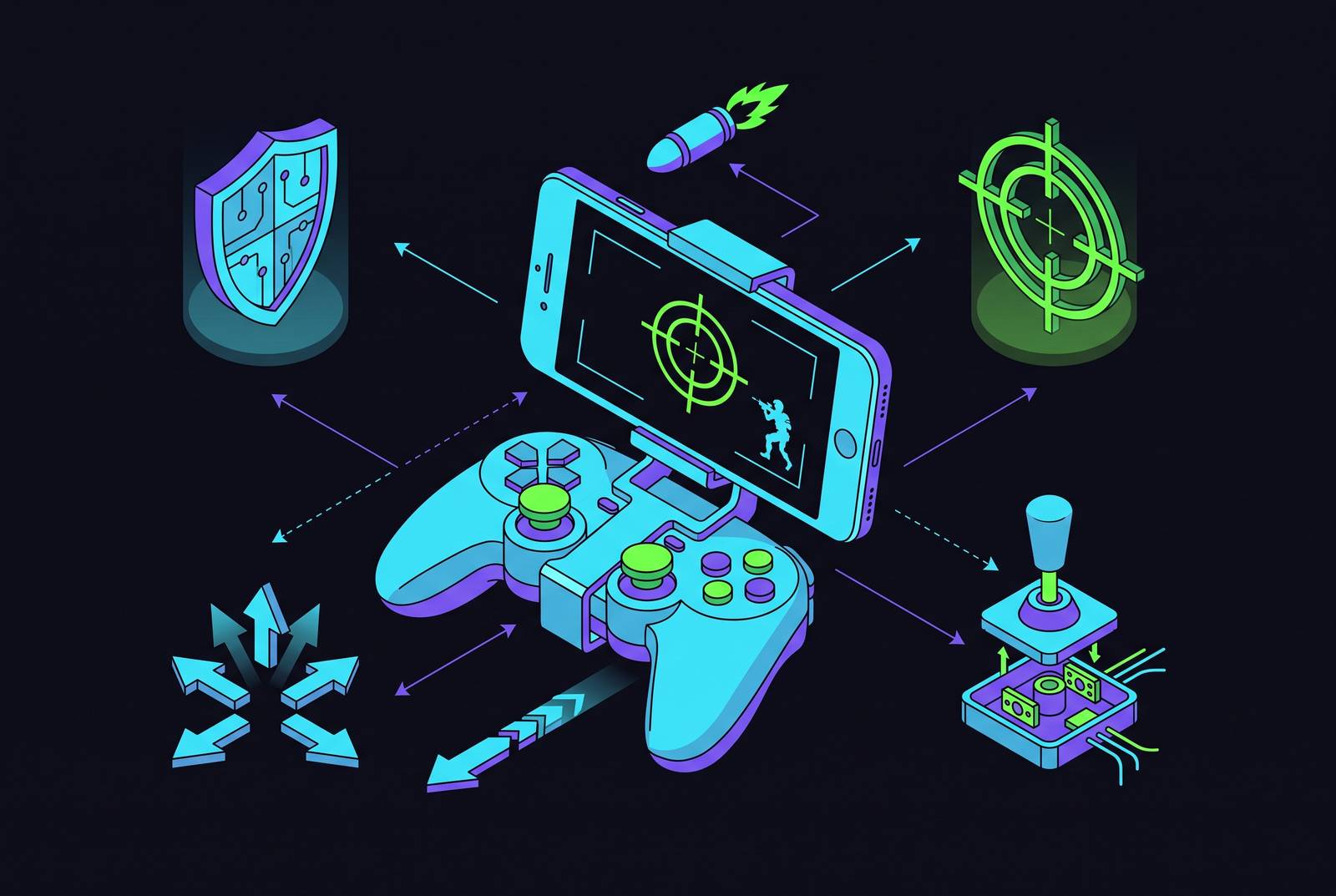
Clip-on controllers, the kind where the phone slots directly into the frame Switch-style, win on portability and simplicity. Standalone pads paired with a separate phone stand trade some of that portability for better ergonomics over a longer sit. The same buying guide offers a useful rule here: skip clip-on models for longer sessions, since fatigue becomes real once a phone's weight hangs directly off the controller's frame instead of sitting propped up on its own.
Platform differences matter before any of that hardware talk even applies. On iOS, a game has to explicitly build in controller support for it to work at all, so check the App Store listing or the developer's own site before assuming anything. Android's system-level support runs broader out of the box, but confirm the specific game responds to gamepad input rather than trusting that system-level compatibility guarantees in-game compatibility.
Check the in-game settings menu regardless of platform, too. Some titles, Genshin Impact being the clearest example, need controller mode switched on manually after pairing, buried under Settings and then Controls. That's not a broken connection: it's just how the toggle works, and skipping that one step is the single most common reason a freshly paired controller seems to do nothing.
Pair the hardware with a free title first, something low-stakes, before trusting it to a paid game or a live-service title. Confirming the connection works on something with nothing on the line beats troubleshooting mid-match in a game where a dropped input costs a ranked point.
Sources
- Best Mobile Games with Controller Support in 2026
- Every Mobile Game with Controller Support 2026
- Best Mobile Games with Controller Support 2026 - AceGamer
- Mobile Games with Controller Support: Best Mobile Controller Games in 2026
- Shooting games for Controller (gamepad) - 42 Mobile Games | Skich
- What Mobile Games Support Controller? 10 Old & New Picks for 2026
- Shooting Mobile Games 2026: The Ultimate Guide to This Year's Best Action Titles - Fletch App
- heresthethingblog.com