Hall Effect Sticks and Drift in Mobile Controllers
Contactless magnetic sensing removes the wear that makes sticks drift.
Stick drift in mobile controllers reflects a hardware lifespan limit that better software cannot remove. Potentiometer sticks wear down because their parts have to touch to read movement. Hall Effect sticks replace that contact with magnetic sensing, removing the main cause of drift. For a controller expected to serve across games and streaming platforms, that makes contactless sticks its most important hardware upgrade.
Why analog sticks drift: the mechanical process that makes it inevitable
A character creeps left when the stick is untouched. During a gunfight, the aim pulls away from its intended target. The game appears to have acquired an opinion. Yet this comes from inside the controller, where a potentiometer relies on physical contact to tell where the stick is. A metal wiper slides across a resistive carbon track, and the controller interprets the changing resistance as movement.
Friction wears the track unevenly, carbon dust sheds into the housing, and skin oils accumulate. Eventually, the wiper reports a slightly wrong resistance value even when the stick is at rest. The game reads that value as directional input because the controller is sending a movement signal, however unintended.
This explains why drift tends to arrive after months of regular play. Standard potentiometer sticks have a finite movement life, and the worn area keeps degrading with subsequent use. What begins as an occasional unwanted movement can become increasingly intrusive. Wear has no reason to stop at merely annoying.
A dead zone is a different thing altogether. It is the small neutral area that a stick ignores by design. Widening that area in software can hide drift by ignoring more of the stick’s movement. But it also sacrifices precision while the underlying damage continues.
Why drift is not a defect to be patched but a lifespan limit built into the hardware
Could making the same design better make it last forever? Not while a wiper has to rub against a track to tell where the stick is. As long as that contact remains, drift is inevitable, regardless of the controller’s price or brand.
Potentiometer sticks can feel good and read movements accurately when new, which helps explain why they have remained the default for decades. Their weakness is lifespan rather than initial quality. So a premium controller can feel excellent at first and still fail in the same way over time.
Movement-cycle ratings show that limit more clearly than a brand name does. Standard sticks are rated for a finite number of movements, and heavy daily play can consume that allowance well inside a year. The rating exposes the finite working life behind an apparently durable object. First-party controllers from Sony, Microsoft, and Nintendo still use potentiometer-based sticks, so a platform logo does not establish drift resistance.
How Hall Effect technology removes the failure point entirely
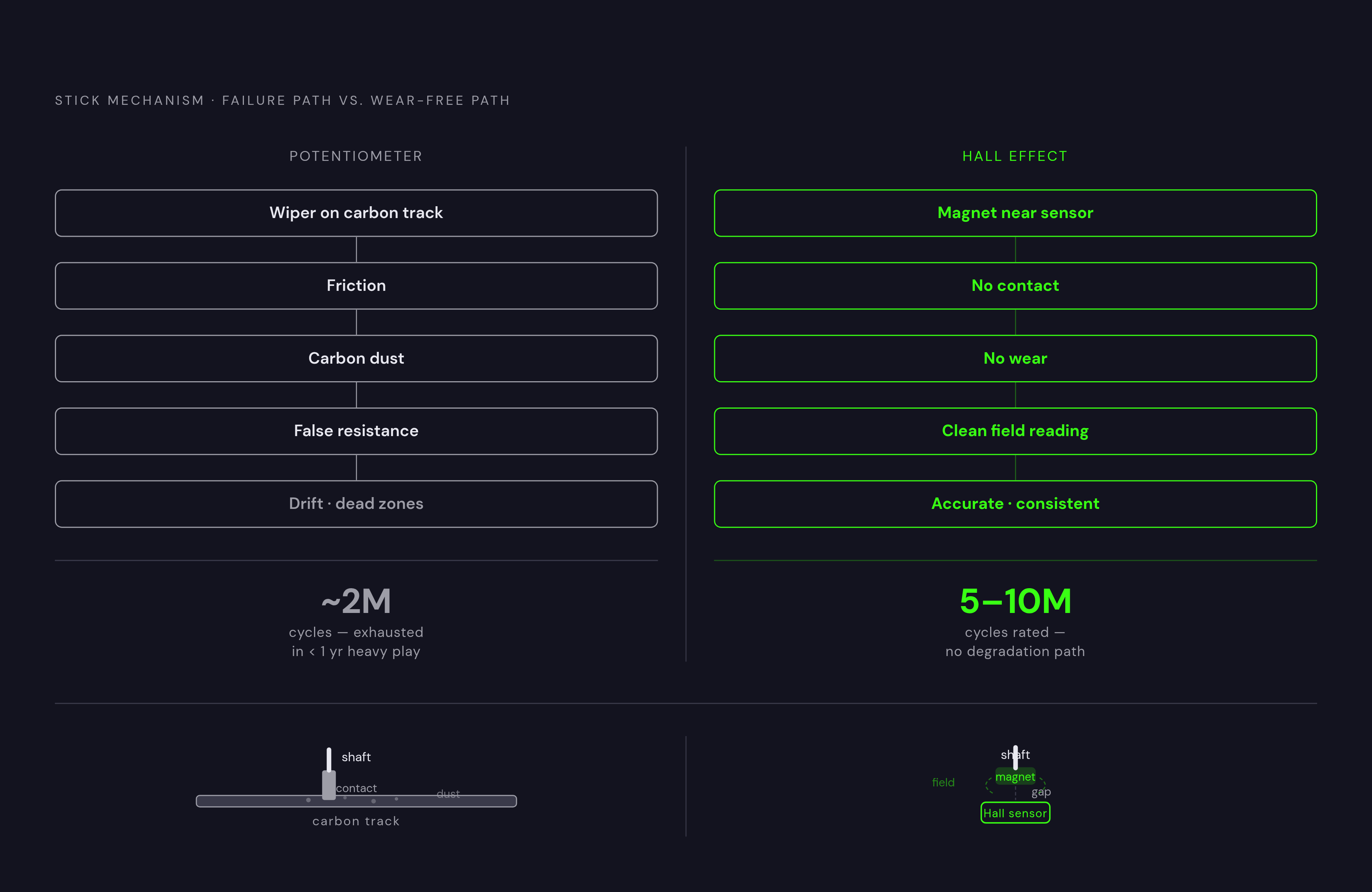
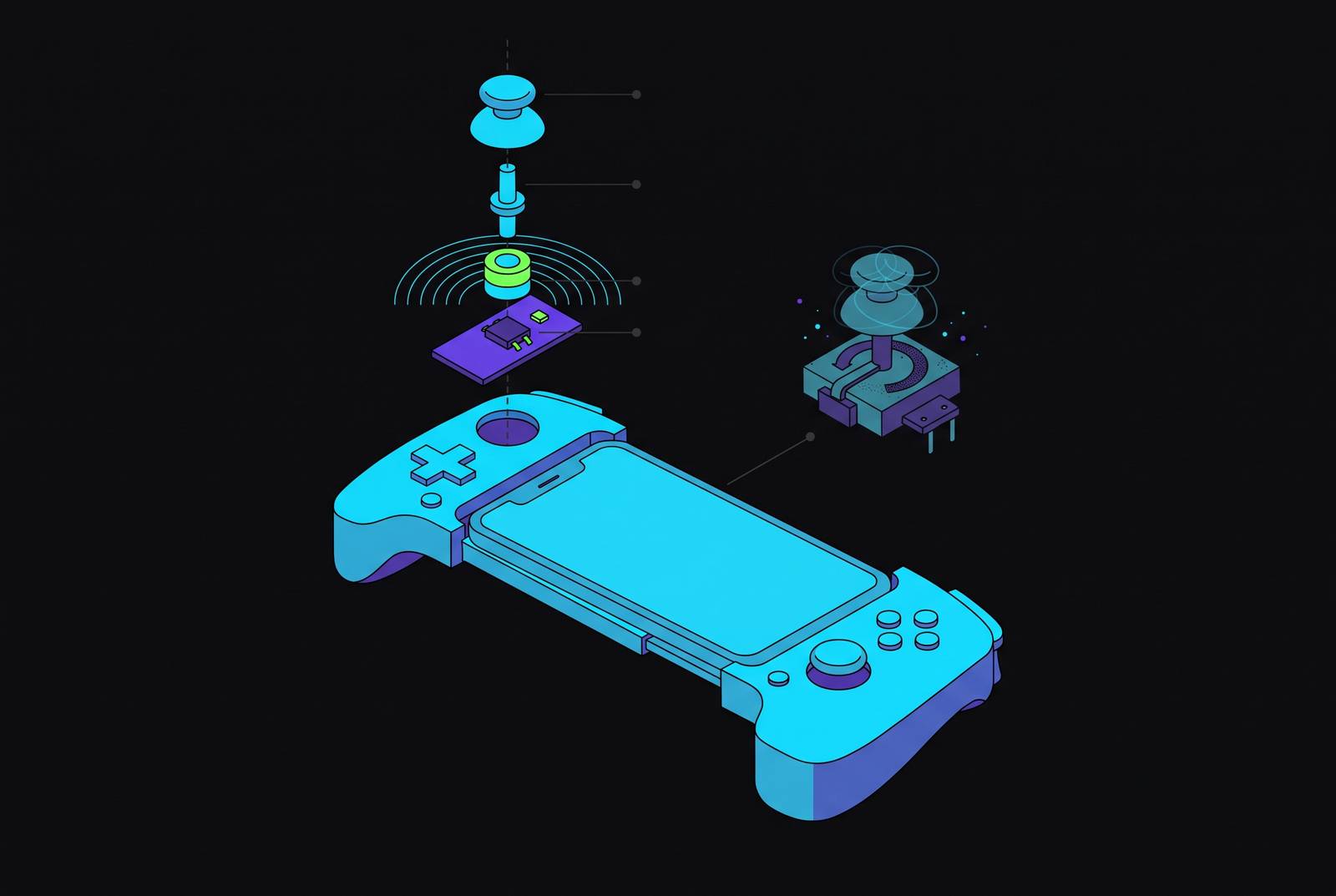
Hall Effect sticks read a magnetic field instead of the resistance where parts rub against each other. A small magnet mounted on the stick shaft moves near a Hall sensor, which uses the surrounding field to calculate stick position. The sensing path needs no physical contact. There is no wiper scraping a carbon track, so there is no track for that wiper to wear away.
“Nothing wears” describes only the contactless sensing path. Hall Effect removes the primary failure mechanism of potentiometer sticks rather than making the entire assembly indestructible. It prevents wear at its source, where software can only conceal its effects.
Several manufacturers say their Hall Effect sticks are rated to last for 5 to 10 million movement cycles. Those ratings estimate how long the sticks will last, but a controller can still fail under some conditions. The precision benefit follows the same physical logic. Magnetic sensing can track smaller movements than a worn carbon track, without the progressive contact wear that degrades a potentiometer’s readings.
TMR, or Tunnel Magnetoresistance, applies the same broader contactless principle through a different sensing technology. It offers tighter tolerances and lower electrical noise than a basic Hall sensor. As of 2026, it appears in a growing number of controllers and is standard across most premium third-party pads, including the Beitong KP20D.
Even so, “drift-resistant” is more accurate than “drift-proof.” Magnet misalignment, a weakened spring affecting center feel, or a bad solder joint can still cause trouble. Extreme temperature swings or strong external magnetic fields could in theory change the readings, though those conditions are far outside normal gaming use. Contactless sensing removes a specific, widespread cause of failure. It does not suspend the rest of engineering.
What Nintendo's €35 million fine established about industry accountability for drift
France’s consumer protection agency, the DGCCRF, fined Nintendo of Europe €35 million in June 2026 after concluding that it had misled consumers about known defects in original Nintendo Switch Joy-Con controllers. The agency found that Nintendo had known about responsiveness failures and drift as early as 2018 but did not inform consumers until 2020. Its finding concerned disclosure.
The DGCCRF classified the delayed disclosure as a misleading commercial practice continuing from 2018 through 2023. Nintendo accepted the settlement and committed to publishing a press release on its French homepage. However, it denied intentional deception and stated that the agreement “does not constitute an admission of guilt.” The settlement and that denial belong together in any account of the outcome. Neither requires treating the case as a verdict on every product the company makes.
The fine was reportedly the agency’s second-highest ever, surpassed only by its fine against fast-fashion retailer Shein in 2025. More importantly, it shows that a known controller failure can become a serious consumer protection issue when buyers are not adequately informed.
In at least one major market, keeping known drift-related problems from buyers came at a high cost, with regulatory consequences narrower than a requirement to use any particular sensor technology. A failure mechanism can be inherent to a design without becoming something consumers must silently accept. Engineering limits and commercial responsibilities are different questions, and the first does not cancel the second.
Why mobile controllers face a steeper drift problem than their console counterparts
Mobile controllers take the same contact-based mechanism into a less forgiving setting. They travel in bags, get used during commutes, and go through temperature swings, often with smaller assemblies made to sell for less. Portability changes the conditions around the sensor. A controller intended to leave the house cannot be judged only by how it behaves when new in a settled indoor setup.
The smaller stick module has less material to wear before readings degrade, while fragmented mobile sessions can involve more stick-centering events per hour of actual play than a long console session. The mechanism remains a wiper moving across a resistive track.
During a streamed session, controller input travels to a remote server, and the result returns as a video frame. A drifting stick therefore sends the wrong command into the game itself. It is not merely a visual blemish on the phone’s screen, and it compounds the latency already present in streaming.
Would a better stream correct that unwanted movement? It would not correct the controller’s false input. Full console games on a phone still rely on the small stick beneath the player’s thumb to tell the game exactly what the player wants to do. The screen may provide access to a much larger gaming experience, but its controls still have to survive mobile use.
What to look for in a mobile controller's stick technology before buying
For a buyer, the practical consequence is to check the named sensor technology before treating any other description as evidence of drift resistance. The specification should say Hall Effect or TMR by name. “Premium sticks” and “precision joysticks” may describe positioning or intended feel while leaving how the controller measures movement unspecified.
Price is no substitute for that information. Some premium controllers still use potentiometers, while Hall Effect has reached a wide range of price points. As of 2026, full Hall Effect arrays are available for under $50. So buyers need to compare contact-based sensing with contactless sensing at the price they have in mind, as well as compare cheap controllers with expensive ones. A larger bill does not change the physics inside a stick.
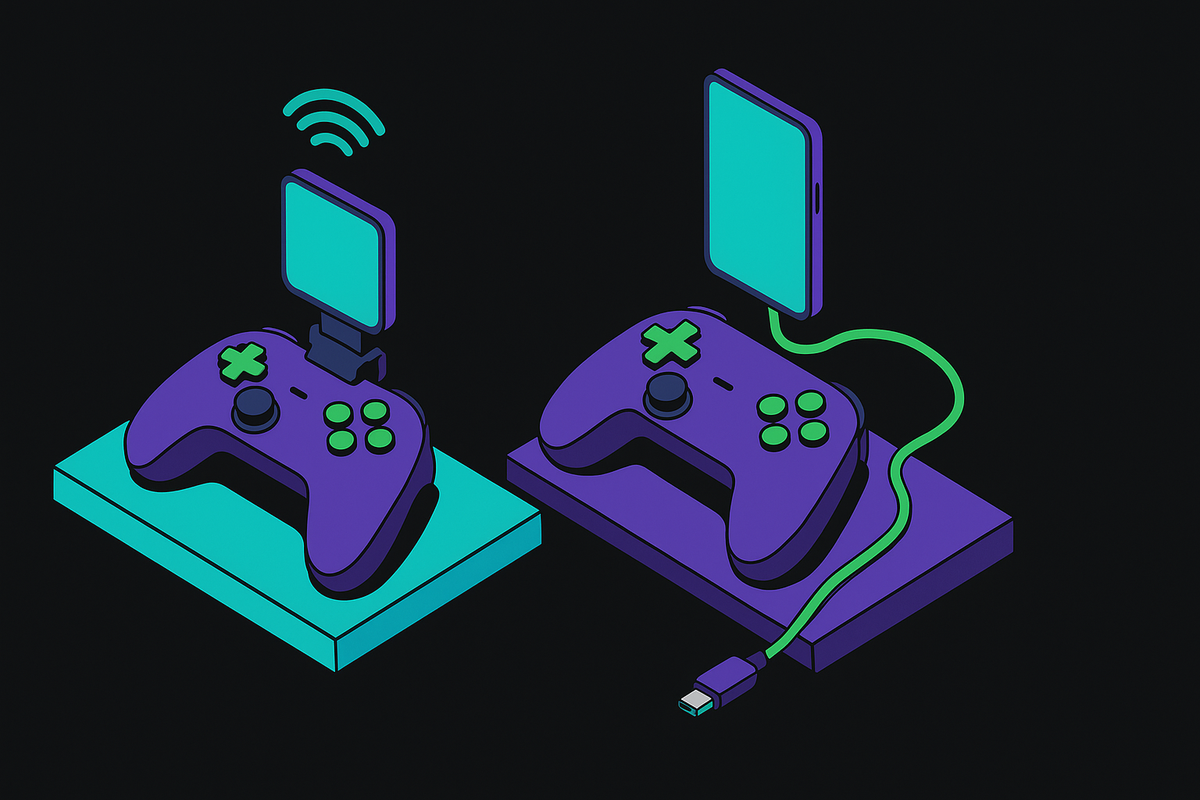
For a mobile controller, that sensor check needs to sit beside phone compatibility and charging support. A narrow supported phone width can rule out the growing share of large-screen devices used for cloud gaming. Pass-through charging addresses a different constraint. Streaming is GPU-light on the phone, but sessions can be long, so the controller should not compete with the phone battery. Durable sticks offer little practical benefit if the rest of the setup cannot support the intended session.
Connection method and grip geometry complete the buying decision. Wired Lightning or USB-C connections add no wireless latency overhead, while Bluetooth introduces a small but nonzero latency variable on top of streaming lag. That difference deserves attention in competitive play. Comfort matters just as much over longer sessions, because tired hands can stop play before the sticks wear out. Hall Effect is the key upgrade against drift, but it still needs a suitable controller around it.
How the cloud gaming landscape in 2026 raises the cost of accepting drift
Xbox Cloud Gaming, PlayStation Remote Play, and NVIDIA GeForce Now let people play full console and PC gaming libraries on mobile screens. The phone receives video while the controller sends inputs to the remote system running the game. That separates the screen in the player’s hands from the hardware doing the game’s work. It does not separate the experience from the quality of its controls.
Access policies also shape how people use that hardware. From November 2026, Xbox Game Pass includes different monthly cloud gaming allowances across Ultimate, Premium, and Essential. Ultimate gives players 15 hours, Premium gives them 10, and Essential gives them 5, and they can buy more time. PlayStation Remote Play remains free and uncapped, strengthening its appeal among heavy users who own a PS5.
Cloud gaming is becoming the dominant model for mobile and casual play, with the majority of global cloud gaming access happening on smartphones. Most mobile cloud users are extending their gaming into commutes and travel while retaining a dedicated console setup. The phone opens another place to play. Its controller becomes the persistent link across those places, platforms, titles, and sessions.
That persistence changes the cost of accepting drift. A worn stick does not impair just one purchase or one game, but every compatible experience reached through the same controller. Contactless sensing makes the controller a more durable investment by removing the wear mechanism that would otherwise put its precision on a countdown. As mobile access expands, Hall Effect gives that owned piece of hardware a better chance of keeping pace with the library beyond it. Great gaming no longer requires a couch or a console, but it does require the right hardware underneath it.