Cloud Gaming Game Library Gaps and What Is Actually Playable on Mobile
Most cloud gaming libraries shrink or vanish mid-playthrough, no matter which service you choose.
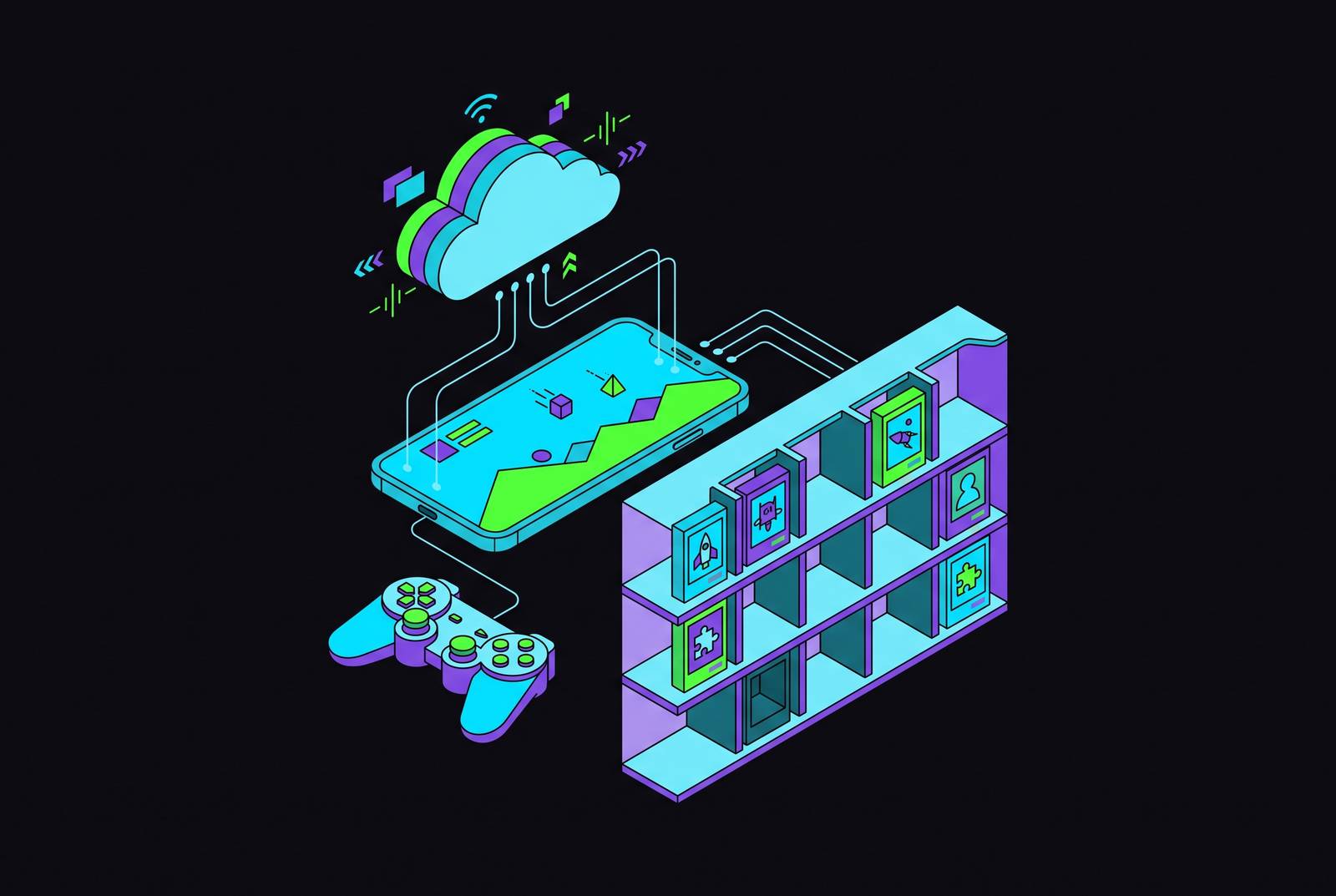
Roughly 455 million people used cloud gaming in 2025, and mobile is a major driver of that audience. The library on any given service is smaller and more conditional than the marketing page suggests: not every listed game actually streams, not every game that streams runs well on a phone, and what's playable today has a real shot at vanishing by next month. This piece goes service by service to explain why, and the position here is blunt: GeForce Now's headline numbers are the least trustworthy in the entire market, and treating any of these libraries as a fixed catalog instead of a moving target is how people waste a subscription cycle.
Downloads across mobile gaming fell about 7% to roughly 49 billion in 2024, while session time climbed 8% and sessions per player jumped 12%. Read that plainly: people aren't grabbing more new games, they're going deeper into fewer of them. That makes "what's actually available to play" a sharper question than it used to be, because a library gap doesn't just mean a missing option. It means a player who already put forty hours into a save file can lose access to it overnight, mid-campaign, with no warning email.
How each cloud gaming model creates a different kind of library gap
Two business models are doing all the work here, and they fail in opposite ways.
Xbox Cloud Gaming, PlayStation Plus Premium, and Amazon Luna run on a subscription library: pay monthly, get whatever the platform has licensed, full stop. You don't own any of it, you're renting a rotating shelf. GeForce Now and Boosteroid work differently: bring your own games (BYOG), meaning the title is already sitting in a Steam, Epic, GOG, Ubisoft Connect, or Battle.net library, and the service just rents you the compute to run it.
Subscription libraries fail through churn. A game leaves the catalog and it doesn't just disappear from a download queue, it disappears from the cloud entirely, sometimes mid-playthrough. Worse, not every title inside the subscription is even cloud-enabled to start with. Some are download-only no matter how long the bill's been paid.
BYOG libraries fail through opt-in, and this is the weaker model of the two, whatever the raw game counts suggest. Publishers have to individually agree to let their games stream on someone else's servers, and that agreement is fragile: Activision Blizzard and 2K Games both pulled titles from GeForce Now not long after launch, and that's still the operating precedent for the whole model. Owning a game on Steam guarantees nothing about whether it runs in a browser tab on a phone.
Two more wrinkles worth naming. DLC and add-ons often don't travel with the base game, since streaming access and downloaded access aren't the same contract even for the same title. And regional licensing carves out gaps that have nothing to do with what's owned or what a service's website claims: the library can be complete and still be locked out, purely because of where the phone happens to be sitting.
Same phone, same list of owned games, wildly different experience depending on which app icon gets tapped. That's the thread running through everything below.
Xbox Cloud Gaming: the widest included library, but not everything streams
Xbox's pitch is scale: over 400 cloud-enabled games bundled into Game Pass, spanning Xbox Game Studios titles, EA Play, Riot Games perks, and a rotating cast of third-party releases. That's a genuinely large number. The catch is that "in Game Pass" and "cloud-enabled" are not the same thing. Some games in the subscription need a full download to a console or PC and never touch the streaming servers at all.
What's actually playable on mobile is still broad. Android phones and tablets get a native app, iPhone and iPad users go through the browser. Recent additions give a sense of range: Hades, Stardew Valley, Cities: Skylines – Remastered, Warhammer 40,000: Darktide, Blue Prince, Call of Duty: Black Ops 7. In October 2025, Microsoft made cloud gaming unlimited for Essential and Premium tier members, and the Essential library became fully cloud-playable on PC, with mobile catching up on the titles already cloud-enabled.
Two features stretch the library past the subscription itself. Stream Your Own Game lets players stream select owned titles that aren't part of Game Pass at all. Separately, Ubisoft+ Premium subscribers can stream supported titles from that catalog without buying them individually. Neither closes the structural gap, though: everything still locks to the subscription. Stop paying, lose the shelf. There's no path to buy a single title and keep streaming it after canceling, a different flavor of ownership problem than the DLC issue over on PlayStation.
On the technical side, Xbox streams the native Series X render at up to 60 frames per second, solid fidelity for a phone screen, especially for anything single-player. Expect roughly 30 to 45 milliseconds of latency at 20 to 35 Mbps for a clean stream, workable on decent home Wi-Fi or a strong 5G connection. There's no high-frame-rate mode above 60 FPS, so competitive shooters hit a ceiling that RPGs and strategy games never notice. Game Pass Ultimate pricing has bounced around, up to $30 a month in late 2025, then back down to $23, still the main door into cloud access on the service.
GeForce Now: the largest reachable library, but "reachable" is doing a lot of work
On paper, GeForce Now wins the numbers game outright: over 1,500 supported titles, stretching to roughly 4,500 once Install-to-Play titles get counted. Nothing else here comes close to that raw count. That's exactly the number to stop trusting at face value, and here's why: "supported" only matters if the game is already owned somewhere, Steam, Epic, GOG, Ubisoft Connect, Battle.net, EA app, or Xbox.
GeForce Now isn't a browsable catalog to subscribe into. It's a rental of GPU horsepower for a library built over however many years of PC game purchases. A Steam or Epic account with forty games and none of them supported makes that 1,500 figure irrelevant to the person holding it. The number describes NVIDIA's server-side licensing footprint, not what any given subscriber can actually play, and those are two different questions dressed up as one statistic.
Mobile access runs through the browser on iOS and a dedicated app on Android. The free tier caps sessions at one hour with queue waits of 5 to 20-plus minutes during peak hours, functional but genuinely annoying on a lunch break. The Performance tier, at $9.99 a month, buys priority access and longer sessions. Ultimate, at $19.99 a month, runs on Blackwell-class hardware (roughly RTX 5080-level), with AV1 encoding at up to 70 Mbps and frame rates up to 240 FPS, the strongest image and motion quality of any cloud service covered here.
Starting January 1, 2026, a 100-hour monthly cap applies across nearly all paid tiers (legacy Founders members are exempt). Anyone streaming daily should do the math on their own habits before assuming Ultimate means unlimited in practice, because it doesn't anymore.
The publisher gap never really goes away either. Licensing disputes can pull a title without warning, and a Steam library, however large, is not a promise of cloud access. One mobile-specific note worth adding: the AV1 and HDR advantage shows up most on a tablet or a TV cast. Squint at a 6-inch phone screen and the gap between GeForce Now's picture and Xbox's narrows fast. This service makes the most sense for players who've already built a serious PC library and want it on a phone without buying anything twice, not for anyone shopping by catalog size alone.
PlayStation Plus Premium: the only place to stream Sony's back catalog, with notable holes
Nobody else offers this: PS3 titles, streaming-only, alongside downloadable original PlayStation, PS2, and PS4 games. Classic PS3-era titles that exist nowhere else in this market. Anyone who grew up with a PlayStation finds their childhood nowhere else on this list.
The sourced number is over 800 titles across the tiers, but read that qualifier carefully: it includes classic-era games that are streaming-only and can't be downloaded to a PS5 for offline play. The catalog looks bigger on the page than it feels in practice, because a chunk of it only exists behind a live connection.
2025 brought a real infrastructure jump: the infrastructure serving those streams was updated, and streaming quality improved as a result. That's a real step up from the PS4-blade era, when server hardware was older and performance more of a coin flip.
The DLC problem deserves flagging hardest for anyone deep into live-service games. Streaming access and downloaded access aren't always the same contract even for the same title, and add-ons don't always travel with the base game. That's a specific, practical gap, not a theoretical one, and it lands hardest in exactly the genre where players have sunk the most money.
Mobile access options are more limited than the bigger services, with no dedicated mobile-first client, though a Windows PC app exists as a secondary path. High-frame-rate options are not documented for any tier. The classic catalog gaps persist too: plenty of fan-favorite PS3-and-earlier titles are still missing, with no offline download option for anything classic-era on PS5. The whole thing reads as curated rather than complete, built for PlayStation-first players who want their franchise history in their pocket. If that history isn't there, the library looks a lot thinner than 800 sounds.
Amazon Luna and Boosteroid: the smaller services that fill specific gaps
Luna's whole pitch is that it's free with Amazon Prime, the lowest-friction entry point on this list for anyone who just wants to try cloud gaming without committing to a thing. Device and regional support varies, and mobile access is not universally available.
Luna+ adds a wider channel library for $9.99 a month, capped at 1080p and 60 FPS, not a quality leader by any measure here. As of June 3, 2026, Luna's bring-your-own-library (BYOL) feature ends entirely: games bought a la carte stay playable for a brief wind-down window, and after that the service becomes a purely curated catalog, no more owning individual titles. The library itself is channelized, Luna+, Prime Gaming, various publisher add-ons, rather than one flat list, which feels scattered on a phone screen already juggling three other apps.
Boosteroid takes a different angle: browser-first, with genuinely broad device reach including a dedicated Android TV app. It follows the BYOG model like GeForce Now, supporting Steam and Epic libraries, and pricing is subject to regional variation and recent changes. Top-tier streaming reaches 4K at 120 FPS, with an entry plan at 1080p and 60 FPS, no free tier at all. The sourced library count runs over a thousand games. Its real use case is regional: wherever GeForce Now's server footprint runs thin, Boosteroid becomes the workable backup.
Neither service competes on catalog depth. Neither has PlayStation's exclusive back catalog or Xbox's subscription breadth. They compete on price and on reaching devices and regions the bigger two haven't fully covered.
Genre and game-type patterns that predict where the gaps hurt most
What actually gets played matters more than which service looks biggest on paper, because the gaps aren't spread evenly across genres. They cluster hard in specific places.
Games that travel well over a cloud connection to a phone: single-player narrative titles and RPGs, where input tempo is slower and the 60 FPS ceiling barely registers. Turn-based strategy and puzzle games tolerate latency fine, since nobody's reflexes are on the line. Open-world exploration fits the deep, extended mobile session pattern almost perfectly, which lines up with that 8% rise in session time from 2024.
Where it falls apart: competitive multiplayer and shooters, full stop. A 60 FPS cap on Xbox, stacked with 30 to 45 milliseconds of latency, puts a cloud player at a genuine disadvantage against anyone on local hardware. Live-service games with DLC run straight into the PS Premium streaming gap. Games pulled from a subscription mid-playthrough, an Xbox-specific risk given the rotating catalog, create the worst kind of loss: the one where sixty hours were already sunk in. Fighting games, with their frame-perfect input windows, sit about as far from cloud-friendly as gaming gets. Streaming just isn't their natural habitat.
Worth naming the cross-platform escape hatch too: games like Genshin Impact and Fortnite let players carry progress across mobile, console, and PC natively, no cloud subscription required. Grand View Research points to that hybrid, cross-platform segment as the fastest-growing corner of the market, and the logic tracks: it sidesteps the entire library-gap problem by not depending on any single streaming service in the first place.
How to match your existing library and play habits to the right service
There's no single best option here, because each service is built for a different starting point, and pretending otherwise does readers a disservice. That said, the sorting isn't hard once the starting point is clear.
A large Steam or Epic library with no console makes GeForce Now the obvious lane, but check the supported-game list before subscribing, not after. A PlayStation history worth carrying in a pocket points straight at PS Plus Premium, with the DLC gap and classic-catalog holes as the price of admission. Wanting the widest included library with day-one first-party releases means Xbox Game Pass, but verify the specific titles in question are cloud-enabled rather than download-only. An existing Amazon Prime subscription with casual habits and no platform loyalty makes Luna close to free money left on the table. A budget-conscious player in Europe or an emerging market with a PC library should give Boosteroid a look as the GeForce Now alternative.
Build the habit of checking before committing. Every one of these services publishes a searchable list of cloud-enabled titles, and cross-referencing it against a personal wishlist takes maybe five minutes, a small tax against burning an entire subscription cycle on a service that doesn't have what's actually wanted.
Some players run two services at once: Xbox for the included AAA catalog, GeForce Now for the PC back catalog, and even stacked together the combined monthly cost sits well under what it takes to build an actual gaming PC (roughly $600 to $1,000 for entry-level hardware, $800 to $2,000 for something capable). That math alone explains a good chunk of this market's growth.
What the library gaps signal about where cloud gaming on mobile is headed
None of this is accidental. Licensing friction, publisher opt-in requirements, DRM architecture, regional server density: these are structural constraints, not bugs waiting on a patch. A software update doesn't undo a publisher's decision to pull a title.
That said, the infrastructure trajectory points up, not sideways. The move from PS4 blade servers to PS5 hardware, Xbox's unlimited-cloud-gaming expansion in October 2025, NVIDIA's Blackwell rollout on GeForce Now's Ultimate tier: each represents a real hardware leap made within roughly a year of the others. That's not coincidence. It's an industry racing to catch up with demand that already showed up uninvited.
What's still unresolved is worth naming plainly rather than guessing at. Whether GeForce Now's new 100-hour cap stays fixed, expands, or gets restructured into different tiers hasn't been announced. Xbox Game Pass pricing has been genuinely unstable: a $30 hike followed by a cut to $23 within months isn't the behavior of a company that's settled on a model. Sony hasn't given any timeline for filling the classic-catalog holes in PS Plus Premium either.
What's clear is that mobile stopped being the secondary screen for this industry a while back. With roughly 455 million users and session time climbing 8% year over year, phones are a primary access point now, not an afterthought bolted onto a console strategy. The practical takeaway for anyone deciding where to spend a subscription: no single service covers everything, the gaps are knowable in advance for anyone willing to check, and pairing a subscription with a BYOG option, or running two subscriptions side by side, beats betting everything on one catalog and hoping it still has what's wanted next month.