Nvidia GeForce Now on Mobile vs Xbox Cloud Gaming Compared
GeForce Now streams games you own; Xbox Game Pass rents a library you never will.
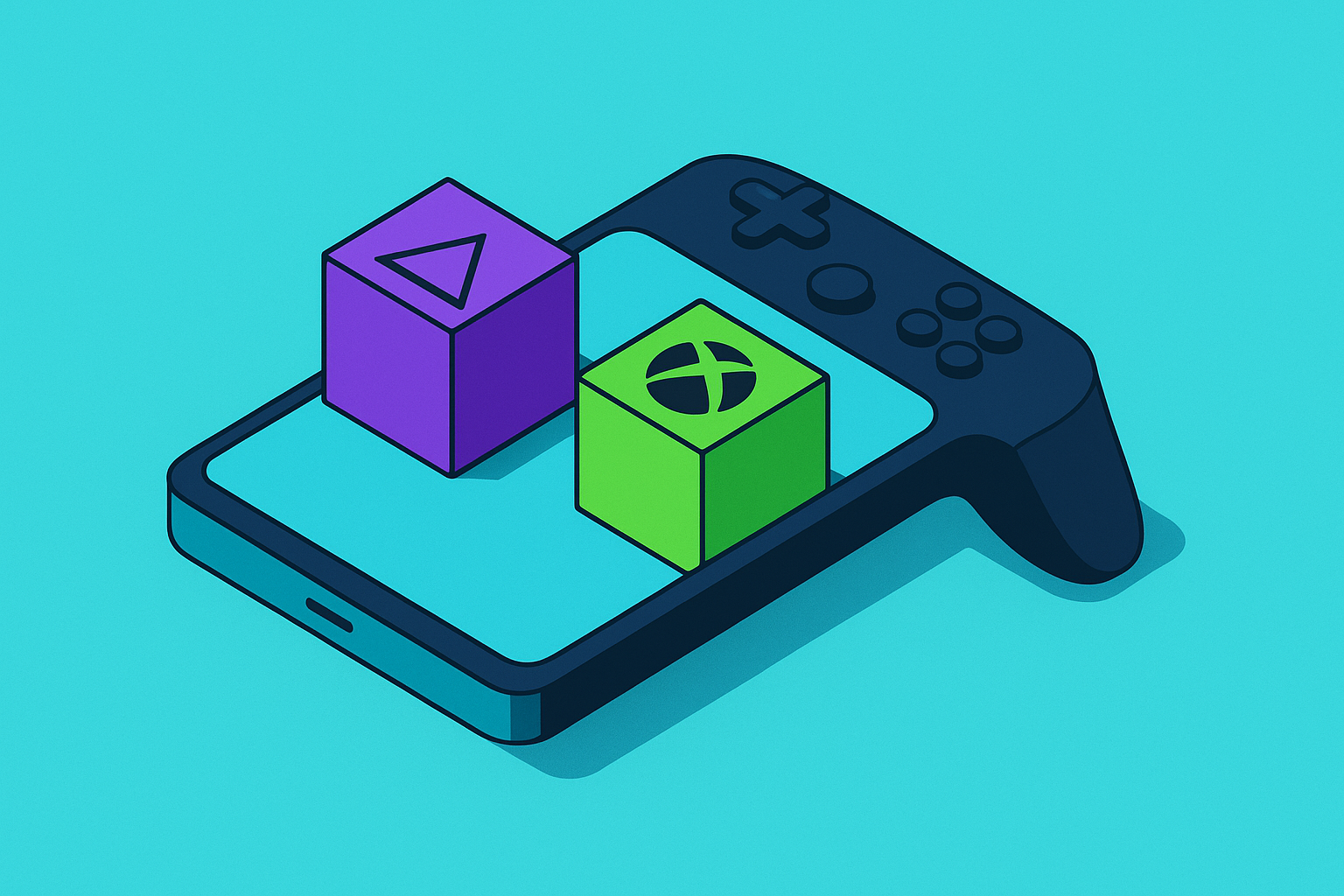
Streaming games to a phone used to be a novelty act. Now GeForce Now and Xbox Cloud Gaming are running a real fight over your home screen, and the two services aren't even competing on the same terms. One rents you compute power to run games you already own. The other rents you access to a library you'll never actually own a single piece of. Every spec, tier, and latency number in this piece traces back to that split, so keep it in mind as we go.
Mobile gaming hit $165.37 billion in 2025 and is tracking toward $196.41 billion in 2026, an 18.8% compound annual growth rate that would make most industries blush. Cloud gaming's user base climbed from 395.9 million in 2024 to 455.4 million in 2025, and phones now carry more than half of all cloud gaming sessions across major markets. Add roughly 3 billion global 5G subscriptions covering 55% of the world's population, per the ITU's 2025 figures, and the picture gets simple fast: the pipes finally got wide enough to carry this stuff without falling apart. For years the real question was whether a phone could handle cloud gaming at all. Now it's which service earns a spot on your home screen, and that's a much more interesting fight to have.
The fundamental difference in what each service is selling
GeForce Now is a compute rental service, full stop. Nvidia takes games you already bought, on Steam, Epic, GOG, Ubisoft Connect, Battle.net, or Xbox PC, and runs them on remote hardware sitting in a data center somewhere, streaming the video back down to your screen. You own the games. Nvidia just lends you the horsepower to run them, and that one fact explains almost everything else about how the service behaves, right down to why the pricing feels more like a utility bill than a Netflix subscription.
Xbox Cloud Gaming runs the opposite direction. Your Game Pass subscription buys temporary access to a library Microsoft curates, and the day that subscription lapses, so does your access to everything inside it. Plenty of players want exactly this deal anyway: no purchase decisions, no library to babysit, somebody else doing the curating so you don't have to think about it.
So who's each one actually built for? GeForce Now fits the PC gamer who's spent years and a few thousand dollars scattering purchases across half a dozen storefronts and just wants that pile of games to be portable. Xbox Cloud Gaming fits the person who wants browse-tap-play with zero financial skin in any single title. Asking which one is "better" without first asking what you're trying to build skips the only question that matters here, and it's the question most comparisons never bother to ask.
What GeForce Now actually gives you — library, tiers, and the new Blackwell performance ceiling
Nvidia's headline number is over 4,500 supported games, pulled from storefronts most PC players already have accounts on. Install-to-Play stretches that further by reaching directly into your personal PC library instead of boxing you into a pre-approved list. Close enough to unlimited that in daily use, it might as well be.
Here's the catch, and it's a real one: publishers have to opt in. Owning a game on Steam doesn't guarantee it shows up on GeForce Now, and if your favorite obscure indie title never made the cut, that gap will bother you more than the math says it should. Small hole, huge library, the kind of detail that never makes the marketing slide.
The bigger story for late 2025 is the Blackwell hardware upgrade. RTX 5080-class GPUs, 62 teraflops of compute, a 48GB frame buffer, numbers that would've sounded like science fiction in a streaming context five years ago. That buys up to 5K resolution at 120 frames per second, or 360 fps at 1080p if you're the type who counts frames instead of pixels. Click-to-pixel response lands as low as 30 milliseconds, with sub-30ms network latency for most users in supported regions. Nvidia claims up to 2.8x faster frame rates than the previous server generation, and more than 3x the raw performance of a PlayStation 5 Pro. Vendor benchmarks always deserve a squint. Cut those figures in half and they're still nothing to sneeze at.
The tiers keep it simple, at least. Ultimate gets you RTX 5080-class hardware, up to 5K at 120fps, DLSS 4 Multi-Frame Generation, HDR, and ray tracing. Performance, formerly Priority, gives you RTX hardware capped at 1440p and 60fps. There's a free tier too, though the session limits make it more of a test drive than somewhere you'd actually want to live.
The part nobody loved: a 100-hour monthly cap for new Performance and Ultimate subscribers as of January 2025, which works out to roughly 3 hours a day spread evenly across the month. Nvidia says fewer than 6% of users ever hit it. Comforting, right up until you do the math on your own habits and realize you might be exactly that 6%. Unused hours roll over up to 15, and going over costs $2.99 per 15 hours on Performance or $5.99 on Ultimate. Install-to-Play users should also budget for optional cloud storage, priced $2.99 to $7.99 a month. None of this breaks the bank by streaming-service standards. It's just a different shape of cost than the flat, don't-think-about-it model some people walk in expecting.
What Xbox Cloud Gaming actually gives you — library, tiers, and what's changed in 2025–2026
Xbox Cloud Gaming rides along inside every paid Game Pass tier, with entry pricing in the single-digit-dollar range a month. The Ultimate tier is where the real value lives, and it actually got cheaper in mid-2026, dropping noticeably in price a month. A rare instance of a subscription price moving the right direction, and worth flagging just for that. That gets you hundreds of games, day-one access to Microsoft's first-party titles, and EA Play plus Ubisoft+ Classics layered on top. Streaming tops out at 1440p and 60fps; no 4K, no high-refresh mode above 60. The hours, though, are unlimited, so there's no cap to track and no overage fee waiting to ambush you at month's end.
One 2025 policy shift is worth calling out directly: new Call of Duty titles no longer land on Game Pass day one. They arrive roughly a year after release instead, and if Call of Duty was your whole reason for subscribing, that's a real change to what you're paying for, not a footnote buried in a patch log.
The feature side has moved fast, faster than the usual pace of these things. The stream-your-owned-games feature, which lets you cloud-stream titles you bought outright instead of only what's sitting in the Game Pass catalog, is now live across all 28 supported regions, covering titles like Subnautica 2 and Monster Jam Showdown. Touch controls, long the weakest link in playing Xbox Cloud Gaming on a phone, now cover games including Avowed, Metaphor: ReFantazio, and Zenless Zone Zero. Real progress for anyone gaming with no controller within reach. As of November 2025, the Xbox mobile app also ships an AI-powered Gaming Copilot offering real-time tips, achievement tracking, and recommendations through voice or text. Whether an AI narrating your backlog appeals to you is a matter of taste. It's there either way, whether you asked for it or not.
Microsoft's reach beyond phones is worth a mention too: Samsung Smart TVs, Amazon Fire TV, and Meta Quest are all in the fold now, which points at a cloud-everywhere ambition that's outgrown the phone-in-your-pocket pitch. GeForce Now covers a similarly wide device spread, for what that's worth. The real pitch for Xbox Cloud Gaming is the ecosystem wrapped around it. If you already live inside Microsoft's world, an Xbox console, PC Game Pass, maybe Microsoft 365 for work, the bundled value here is genuinely hard to recreate by stitching together separate subscriptions yourself.
How the two services compare on streaming performance and latency
GeForce Now leads on raw streaming performance. Xbox Cloud Gaming leads on tight optimization for its own first-party catalog. Neither point is really up for debate, and neither one cancels the other out.
The resolution gap isn't subtle. GeForce Now Ultimate runs up to 5K at 120fps with HDR and ray tracing on, capable of pushing something as demanding as Cyberpunk 2077 at settings that would strain a mid-range gaming laptop. Xbox Cloud Gaming caps at 1440p and 60fps, with no 4K or higher refresh rate anywhere on the announced roadmap. Reviewers running side-by-side tests through 2025 and into 2026 keep landing on the same verdict, that the GeForce Now stream looks sharper and holds more detail. At this point that's closer to settled fact than hot take.
Latency tells a similar story, though the comparison gets lopsided fast, mostly because of how differently the two companies talk about it. Nvidia publishes hard numbers: as low as 30 milliseconds click-to-pixel, sub-30ms network latency for most users in supported regions. Microsoft publishes nothing comparable. Xbox Cloud Gaming runs fine on a stable connection, but there are enough reports of input lag and visual artifacts once that connection wobbles that it's worth naming instead of waving off as ordinary internet noise. Microsoft's own marketing describes Ultimate streaming as running "at its best quality with the shortest wait times," a sentence built to reassure you while measuring almost nothing. Nvidia hands you a number. Microsoft hands you an adjective.
Xbox's server infrastructure runs on Series X-class hardware tuned specifically for Microsoft's own games: Halo Infinite, Starfield, that sort of thing. Tight optimization for a known, fixed set of titles can matter more day to day than a generic resolution ceiling, especially when those happen to be the games you're actually playing every week. Nvidia optimizes for breadth across thousands of titles it doesn't control. Microsoft optimizes for depth across a catalog it built top to bottom itself.
Here's what most comparisons skip, and it matters more than either company's spec sheet: you're probably looking at a 6-inch screen, not a 32-inch monitor. The visible gap between 1440p and 5K shrinks fast at that size, to the point it barely registers on a subway ride. What you actually feel on a phone has a lot more to do with latency and input response than raw pixel count. Which is exactly where the controller conversation starts.
Where a mobile gaming controller changes the equation for both services
Both services offer touch controls. Neither one was built around them for anything beyond casual play, and no overlay, however clever the button mapping, replicates the feel of an analog stick under your thumb. A physical controller is what actually closes the gap between playing on your phone and playing on your console.
For GeForce Now this matters more than it sounds like it should. You're streaming PC games, and PC games are designed assuming a gamepad, or a keyboard and mouse, sitting nearby. Try running most of that 4,500-game library with your thumbs smearing across glass, and you'll understand fast why a controller here isn't a nice-to-have. It's closer to a requirement.
Xbox Cloud Gaming's touch control expansion, Avowed, Metaphor: ReFantazio, Zenless Zone Zero, is genuine progress and deserves credit for what it is. It still only covers a slice of the catalog, though. For the rest of the library, a physical controller stays the right tool for the job, not something you can shrug off because the app looks polished on the surface.
There's a compounding effect worth naming here. That 30-millisecond click-to-pixel figure GeForce Now advertises assumes your input reaches the server cleanly, with no added delay tacked on at your end. A laggy or imprecise controller adds friction to a chain Nvidia has otherwise worked hard to shrink toward zero. Good hardware protects the low-latency experience Nvidia built. Bad hardware quietly wrecks it, and you'll end up blaming the service instead of the bargain-bin clip-on controller you bought on a whim at an airport kiosk.
And once your setup gets comfortable enough that you forget you're even streaming, you'll naturally play more. That's the exact point where GeForce Now's 100-hour cap stops being a line item in the terms of service and starts being something you actually have to plan around.
Which service fits which type of player
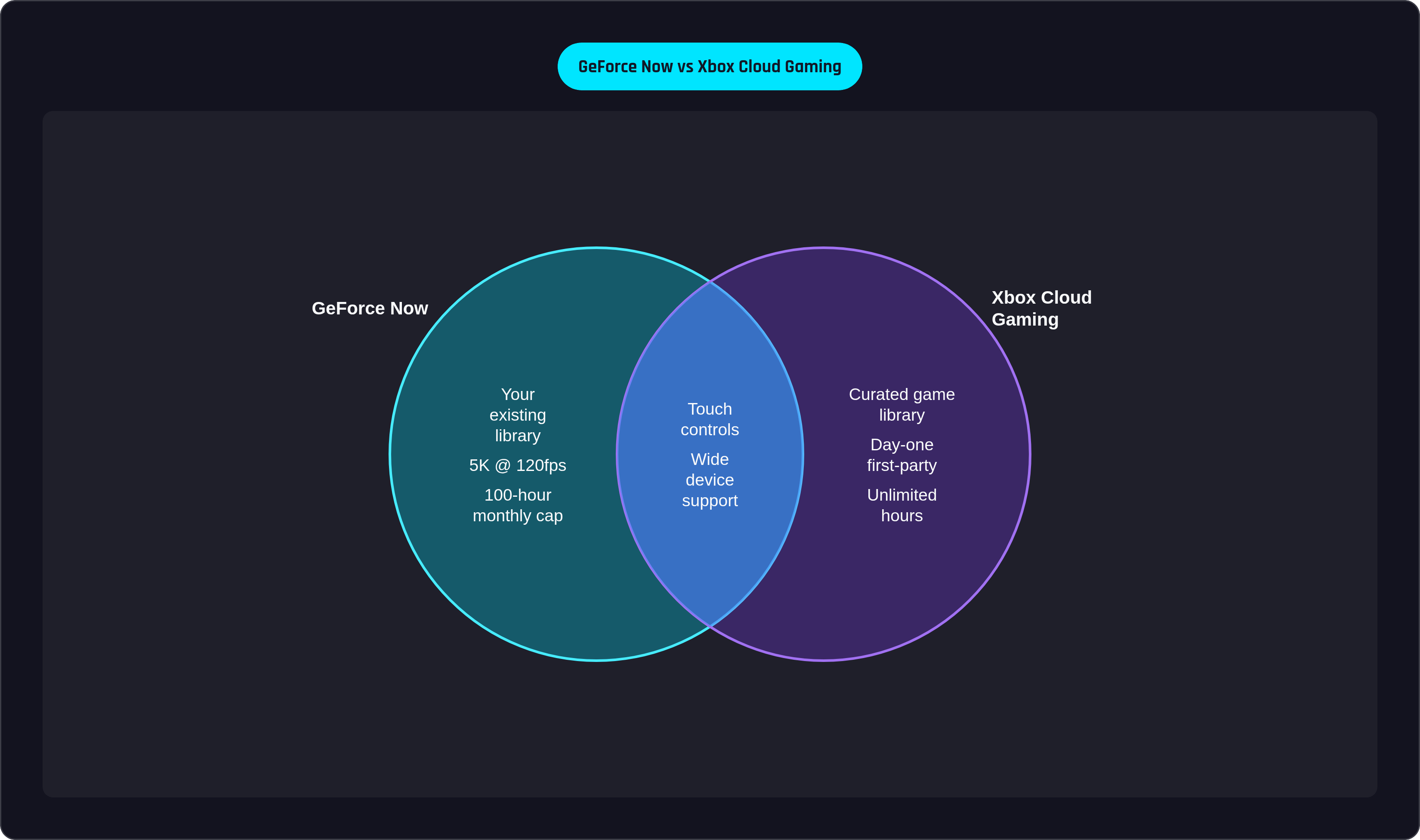
GeForce Now makes the most sense if you already own a real PC library, years of purchases scattered across Steam, Epic, GOG, or similar, and have zero interest in re-buying any of it somewhere else. It's also the right call if image quality and low latency genuinely matter to how you play, if you like demanding games and want your phone to look like a high-end rig instead of a compressed knockoff of one. It suits players whose taste runs wider than any single subscription catalog could realistically cover. The 100-hour cap works fine for most people, so long as you're honest with yourself about how many hours you're actually logging. That's the part people tend to fudge, myself included some months.
Xbox Cloud Gaming fits better if what you want is a curated, steadily growing library with zero purchase decisions attached to it. It's the clear pick if you're already living inside the Microsoft ecosystem, an Xbox console, PC Game Pass, or both, since that bundled value is genuinely hard to replicate by piecing together separate subscriptions on your own. Day-one access to first-party Microsoft titles is a real draw, with that Call of Duty timing shift now baked into the math you're doing. And if tracking a monthly hour allowance sounds like one more thing cluttering your life, unlimited streaming just deletes it from the list entirely, with Gaming Copilot and growing touch-control support as reasonable extras on top, if that's the kind of thing that appeals to you.
Plenty of players end up running both. GeForce Now for the PC library they spent years assembling, Xbox Cloud Gaming for the first-party titles they don't want to miss on day one. That's a legitimate setup, not a compromise born of indecision. Still, actually run the numbers on the combined monthly cost before assuming it nets out fine; it's easy to talk yourself into "it's not that much more" without ever checking the receipt.
The phone in your hand is already good enough for either service at this point, that argument's basically over. What decides your actual experience now is your connection, and whatever you're holding onto while you play.