Snapdragon Chips in Android Handhelds Explained
Driver maturity, not price, decides which Snapdragon handheld to buy.
Android handhelds use Snapdragon chips at many prices, but the chip that costs the most is not always the best buy. The useful distinction is what each tier can play with mature drivers today. For most buyers in 2026, the Snapdragon 8 Gen 2 offers the strongest balance, while older chips, dedicated G-series silicon, and the 8 Elite suit more specific needs.
Why the chip inside an Android gaming handheld is the one spec that actually determines what you can play
Buying a handheld for one particular game, then discovering that it stutters or refuses to run, is an expensive way to learn about processors. The controls might feel right, and the screen might look great. Neither can rescue an unsuitable chip. Android handhelds collectively span everything from Atari 2600 emulation to Switch-era games, with individual devices covering different parts of that range.
The chip therefore sets the practical limit on the library a handheld can handle locally. Screen size, battery, and controls are easier to compare before buying, which can leave the least visible specification doing the most consequential work. Yet raw speed is only half the question. Driver maturity sets how well emulators can use that speed, and the fastest processor does not always have the best driver support.
How Qualcomm structured the Snapdragon lineup for handhelds, and why that structure matters to buyers
Qualcomm’s handheld presence follows two parallel tracks. The first draws on smartphone processors, from older Snapdragon chips to recent flagships adapted for handheld use. Their appeal combines processing power with an established driver ecosystem. They were not designed solely for handheld gaming. Because these chips started out in smartphones, the same chip family can turn up in devices built for very different uses.
The second track is the dedicated G-series, built for sustained handheld performance within tight thermal and battery constraints. Its purpose is different from borrowing a fast phone chip. The lower-tier G1 Gen 2 is mainly for cloud streaming, while the G2 Gen 2 is an entry-tier chip built for gaming.
For buyers, the distinction changes how benchmark comparisons should be read. A G-series processor and a phone processor can post similar scores without behaving identically during sustained play, because their thermal management and sustained-load behaviour are engineered differently. A score is not a complete portrait. The two tracks overlap in the games they target, but approach the handheld’s constraints from different directions.
Why Turnip drivers make Snapdragon the default safe choice for emulation, regardless of which tier you buy
Snapdragon’s strongest emulation advantage is not simply speed. Turnip, an open-source Vulkan driver from the Mesa project, works with Qualcomm Adreno GPUs and gives users an alternative to the manufacturer’s graphics driver. Compatible Android apps that embed libadrenotools can load a replacement driver from a zip file without root access. That replacement applies only inside the app.
This means a graphics problem on Snapdragon can often be addressed through a community driver update. By 2025, Turnip was built by default in Mesa for ARM64 targets, reflecting how established that infrastructure had become. The distinction is tangible in the Retroid Pocket Flip 2. Its Snapdragon 865 model supports custom Adreno/Turnip drivers that help with Switch and PC emulation, while its Dimensity model cannot use them. For a buyer who is unsure which of those versions to choose, the Snapdragon model is the safer pick.
An older chip can have years of community work behind it, while a faster newcomer still has gaps in support. So a chip that loses in a benchmark can win at emulation. Snapdragon gives buyers access to this ecosystem, but they still need to check how mature the driver support is for the chip they choose.
What the entry tier — Snapdragon 662 and 865 — actually runs, and who should still buy it
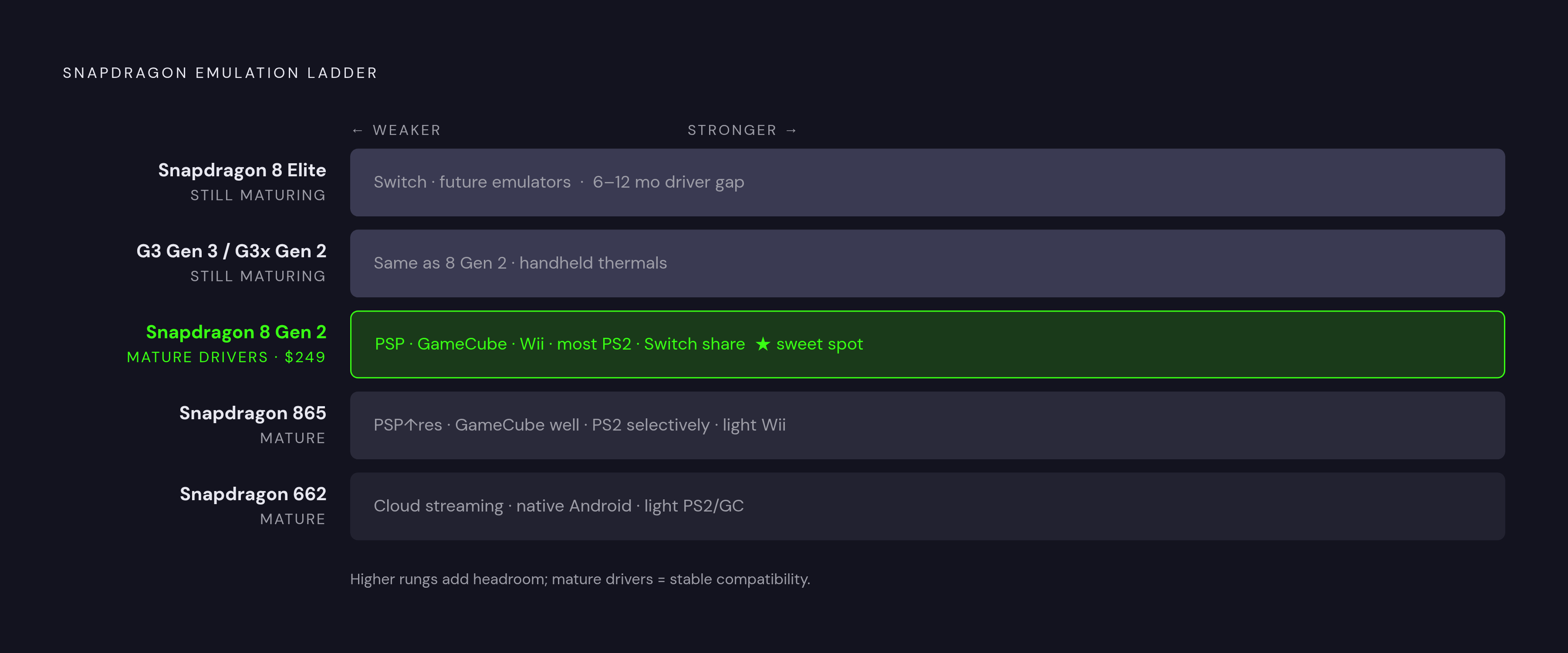
The Snapdragon 662 remains useful when the workload fits. It handles cloud streaming and native Android games smoothly, while heavier emulation exposes its limits. PS2 and GameCube performance is decent, but games beyond that generation will struggle. It is a lower-cost match for buyers whose intended library does not demand more.
That tradeoff makes even more sense for cloud-first use because the handheld does not have to do the heavy work of running the game locally. Android supports Xbox Cloud Gaming, NVIDIA GeForce NOW, PlayStation Remote Play, and Steam Link across these tiers. The important distinction is between running a game on the handheld and receiving a stream from elsewhere, rather than between a modest processor and a flagship.
The Snapdragon 865 offers a stronger local emulation proposition. It runs PSP excellently at increased resolution, handles GameCube very well, and supports PS2 selectively, with lighter Wii titles also within reach. Its age is not the whole story. Although it was a 2020 flagship, accumulated driver maturity keeps it practical in 2026. Buyers focused on those systems have a concrete reason to consider it rather than paying for performance their library will not use.
Why the Snapdragon 8 Gen 2 is the practical sweet spot for most buyers in 2026
The Snapdragon 8 Gen 2 brings a much broader library within comfortable reach. NES through PS1, N64, Dreamcast, and PSP are trivial workloads for this tier. GameCube and Wii games, including demanding titles, run at increased resolution through Dolphin, while NetherSX2 runs most of the PS2 library with a good deal of upscaling. A meaningful share of the Switch 1 library also runs well. That last qualification is important, because credible Switch emulation is not a promise that every game works.
Its decisive advantage is how mature drivers meet that processing power. A newer chip can offer more theoretical performance yet deliver less in a particular emulator because its driver support has not caught up. The 8 Gen 2 avoids much of that mismatch. Its established support can make it faster in practice than newer silicon in some emulation workloads, despite what a benchmark suggests.
Why pay for a faster processor if the game it is bought for cannot use the extra speed? For buyers who want reliable access to their library now, rather than the prospect of improvement later, that question puts driver maturity beside raw speed as a purchasing criterion. This explains why the 8 Gen 2 remains the default choice, with both driver maturity and a lower price in its favour.
Price completes the case, with devices using the chip starting at $249. The AYANEO Pocket DS and Pocket EVO cost more and have larger OLED panels and higher-end builds, with the same 8 Gen 2-class performance. Those options separate the decision about processing power from the decision about the rest of the handheld.
Where the G-series dedicated chips sit in the hierarchy, and what purpose-built gaming silicon changes
The Snapdragon G3 Gen 3 and G3x Gen 2 sit in the middle for performance, but placing both on one rung above or below the 8 Gen 2 overlooks what they were built to do. They belong to the dedicated track. Their distinguishing proposition is handheld-oriented thermal management and sustained-load behaviour.
The G3x Gen 2 is positioned as Qualcomm’s flagship dedicated handheld platform. It combines an octa-core Kryo CPU, including a core running up to 3.36GHz, with an Adreno A32 GPU running up to 1.0GHz. Those specs show how high it aims, but they do not prove that it beats phone-derived chips in every case. Purpose-built does not mean free of software tradeoffs.
In particular, the G-series driver ecosystem is newer than the 8 Gen 2’s. These chips still need years of community Turnip work, so buyers need to check how mature their driver support is, just as they would with other newer processors. Their buyer profiles overlap, but are not identical. The G-series suits buyers drawn to handheld-specific chip behaviour who are willing to accept still-developing driver support, while its expansion downmarket suggests a longer-term platform strategy.
What the Snapdragon 8 Elite adds at the top of the hierarchy, and why early adopters pay more than a benchmark premium
The Snapdragon 8 Elite offers the highest performance in the Android handheld category. Its extra headroom targets Switch emulation and future emulators that push beyond current demands. The AYN Odin 3 provides the clear device example at this tier. For buyers planning around what emulation software may do next, rather than only what it does today, the flagship has a distinct purpose.
However, some of that performance remains out of reach in certain emulation workloads while drivers mature. The expected catch-up period is at least six months to a year. That is a real purchasing cost. Early adopters pay more for hardware whose full power they cannot yet use all the time, and that limit should count for more than a footnote beneath a high score.
The Odin 3’s setup process makes the constraint concrete. A custom Turnip GPU driver step provides the software support needed to run Switch and Wii U titles that the stock driver will not run. At the flagship end, the driver becomes a gatekeeper.
Is buying inaccessible headroom irrational? Not necessarily, if the buyer accepts the present gaps and intends to keep the device as support improves. Driver development can make more of the existing hardware usable without a hardware upgrade. The 8 Elite is consequently the enthusiast choice for maximum headroom and a longer horizon, rather than the automatic recommendation for someone who wants the least friction today.
What the Arc X1 and the G2 Gen 2's India-first launch reveal about where the category is heading
The Arc X1 brings dedicated gaming silicon to a more affordable price tier. The Snapdragon G2 Gen 2 first shipped in the Retroid Pocket G2 in late October 2025 and is set to appear next in Anbernic’s dual-screen RG DDS. The Arc X1’s significance is its price positioning. It is a market signal whose promise remains unproven.
The chip uses a 4nm process, an octa-core Kryo CPU, and an Adreno A22 GPU designed specifically for handheld gaming. Bringing that dedicated approach downmarket could change what buyers expect from budget Android handhelds. If buyers take to dedicated silicon at this price, other makers could feel pressure to use it in their next round of products, which could bring the two tracks closer together.
The India-first launch gives that strategy a particular audience. India added millions of mobile gamers in a recent one-year period, driven by affordable 5G smartphones, making it the fastest-growing mobile gaming market. Accessible pricing is central to that opportunity.
Matching chip tier to use case: a practical decision framework for buyers
Answer three questions in order: what do you primarily play, how much driver maturity do you need today rather than in a year, and what does the device cost to run with a controller? Start with the library. For cloud-first gaming, the Snapdragon 662 tier is rational, while the 865 is the stronger entry-level fit for PSP at increased resolution and the more demanding retro workloads described above.
For upscaled PS2, GameCube, and Wii, plus a credible share of Switch 1 games without early-adopter friction, the Snapdragon 8 Gen 2 is the default recommendation. Its $249 entry point makes that balance accessible. Buyers who instead prioritise dedicated handheld chip behaviour can consider the G3 Gen 3 or G3x Gen 2, provided they accept a newer driver ecosystem. Those seeking maximum headroom for Switch and future emulators should look to the 8 Elite only with the patience and budget its current driver gap requires.
Supported streaming services bypass the demand for high local gaming performance, but PlayStation Remote Play is not true cloud gaming, and PlayStation Cloud Gaming is not supported. The service must fit the intended use. Once that is settled, a higher chip tier is worth paying for only if the games can use the extra power, the drivers will be ready in time, or the buyer wants more headroom.